"The Church exists for nothing else but to draw [us] into Christ."
C.S.Lewis
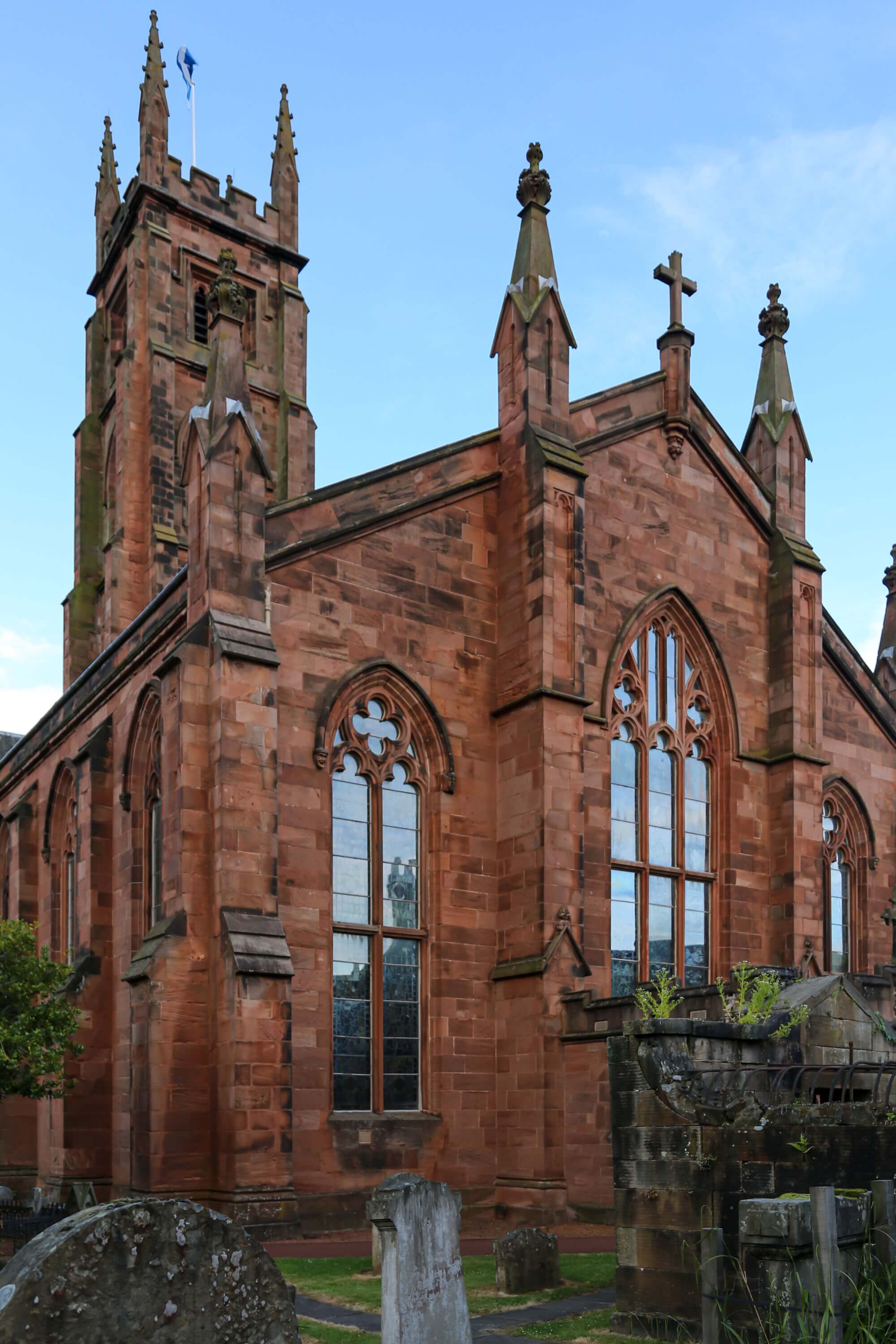
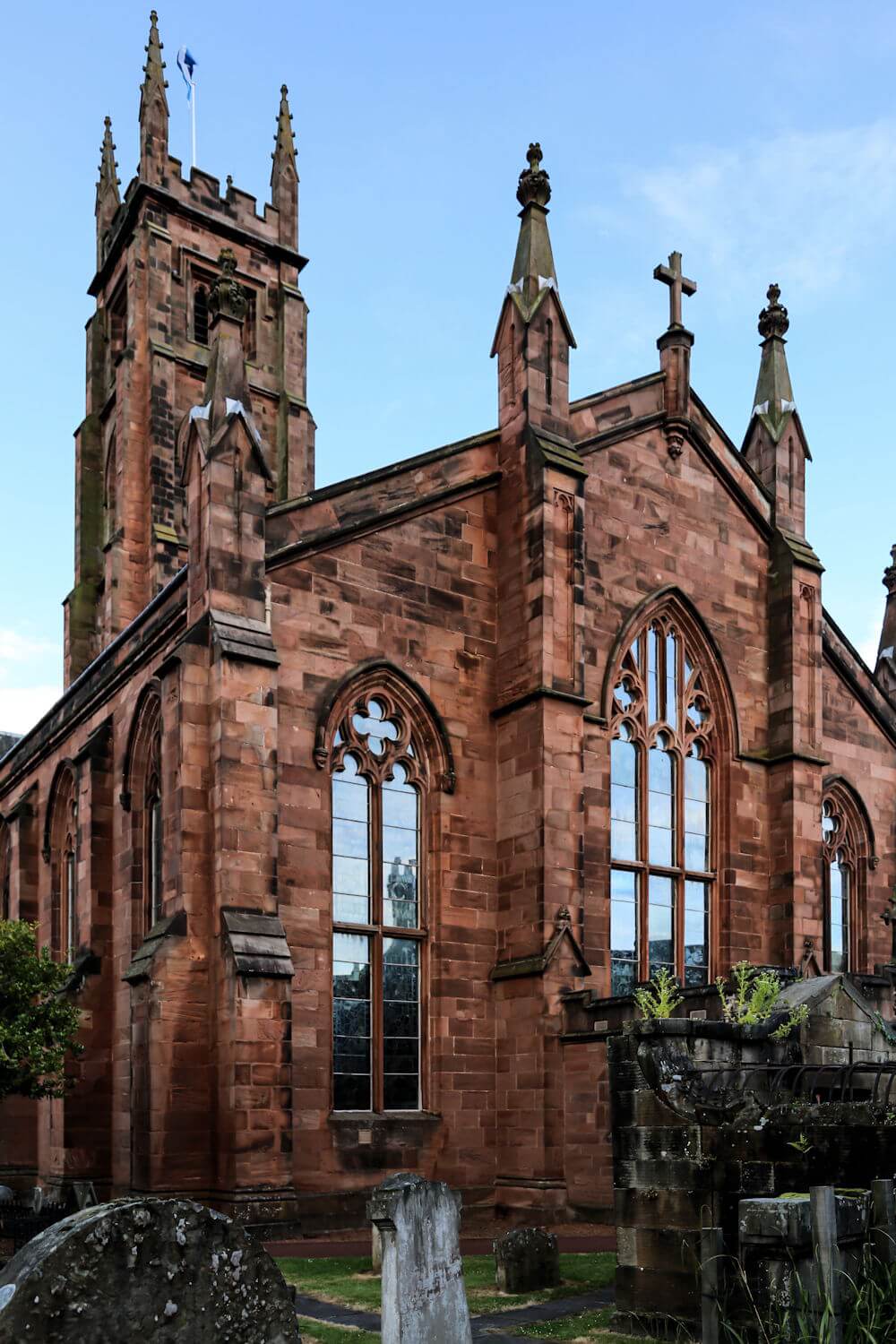
Join us in our church building in Bothwell, a site where worship has been held since the 6th Century.
Traditional Sunday Services at 10:30 every Sunday.
The History of the Church
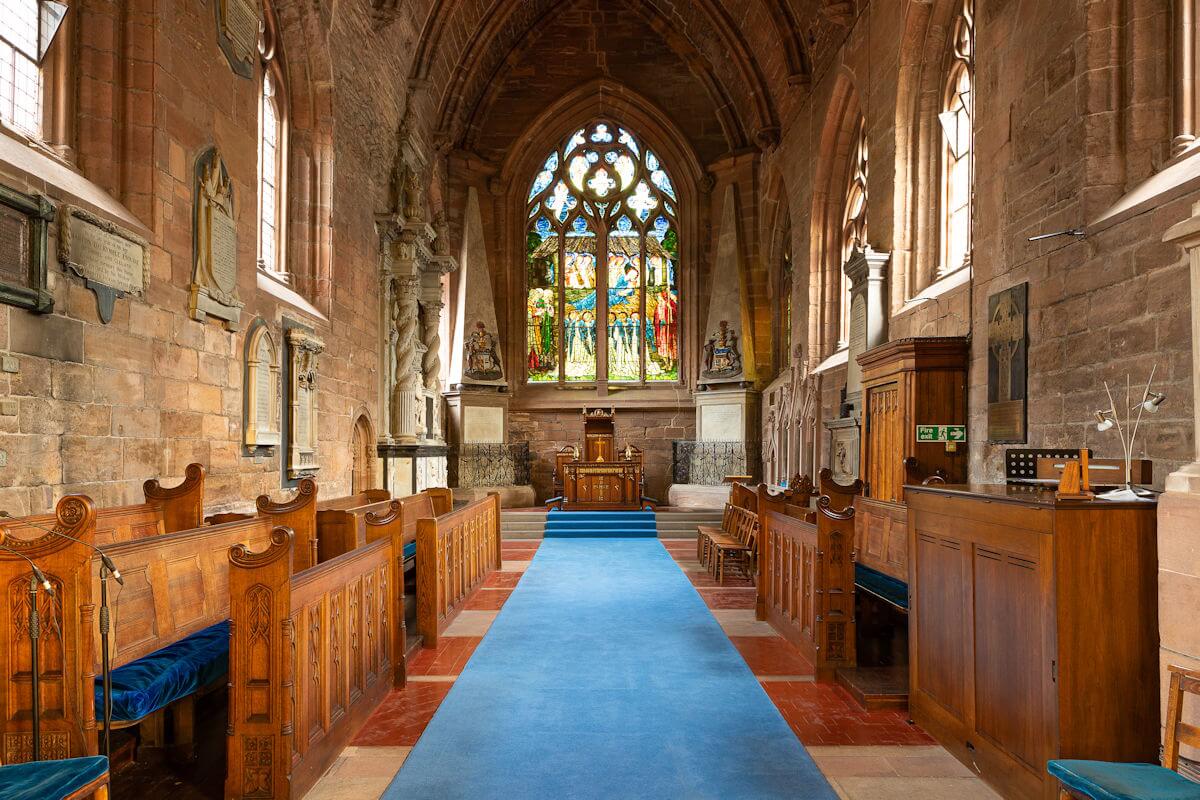
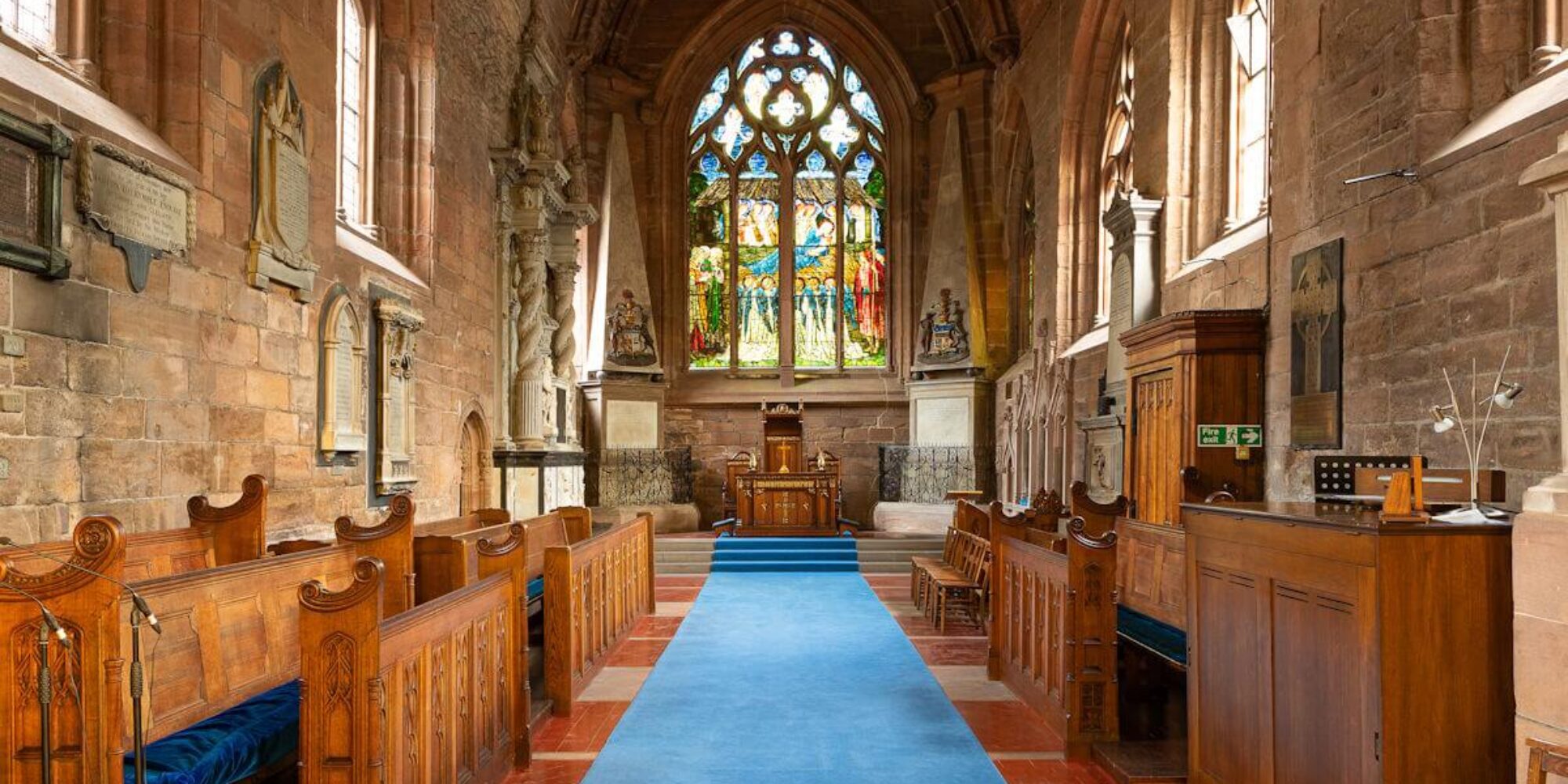
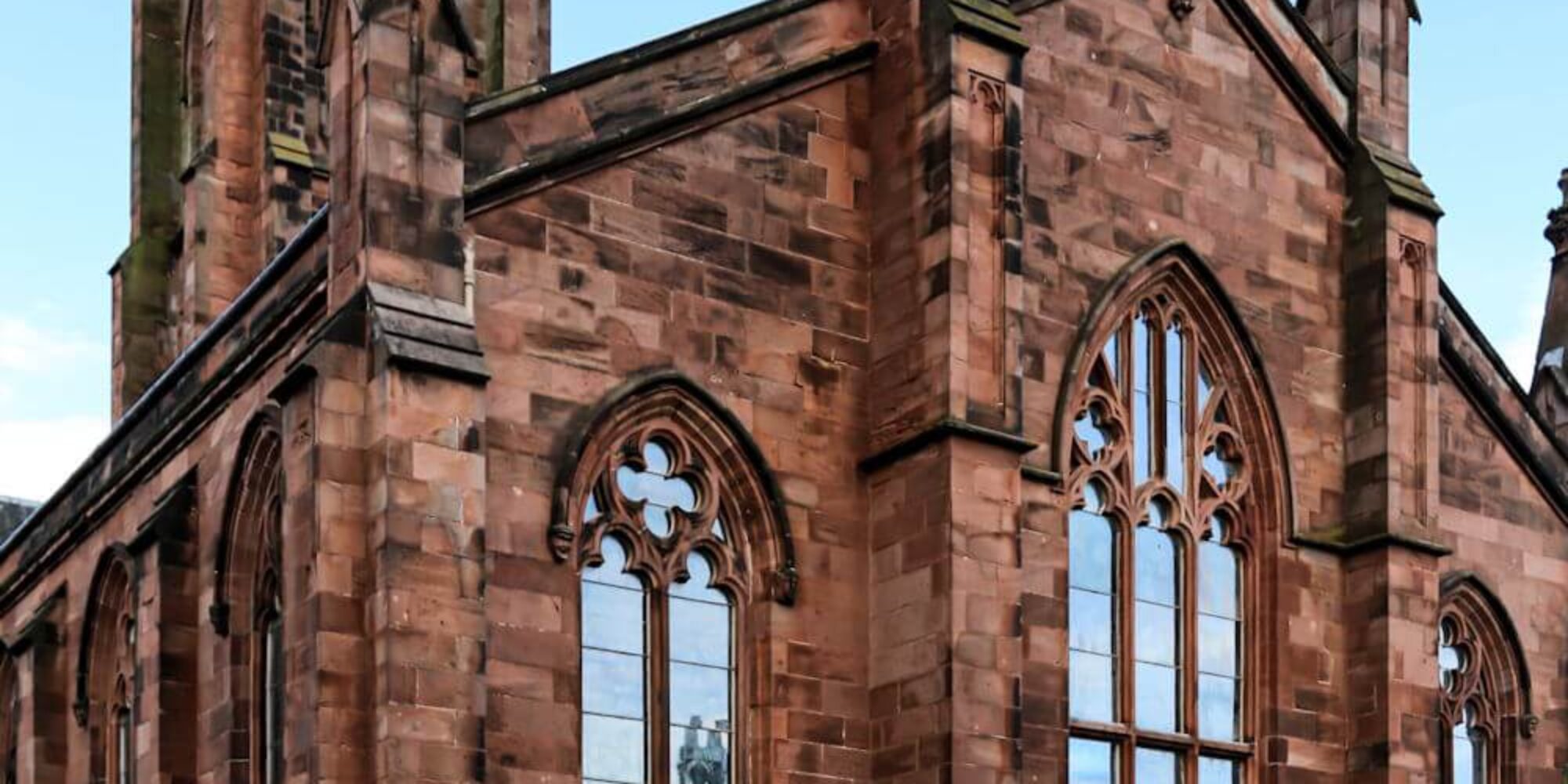
For centuries, worship has taken place on this remarkable site, and we give thanks to God that we continue that tradition today within our Grade A listed building. The church stands where a 6th-century place of worship once stood, originally dedicated to St Mary and later linked with St Bride. At its heart remains a beautifully preserved medieval Quire, part of a chancel that has witnessed the prayers of countless generations.
Much of the medieval structure was shaped by Archibald Douglas, known as The Grim, who became the Third Earl of Douglas in 1389. He added this Quire to an earlier Norman building with the intention of establishing a new Collegiate Church. With permission from Pope Benedict XIII, Bothwell Parish Church became home to a collegiate body of priests, six initially, later increased to eight at Douglas’s request, who were tasked with celebrating mass continuously for the souls of Douglas, his family, and others he named. The Collegiate Church of Bothwell was formally dedicated on 10 October 1398, just two years before his death.
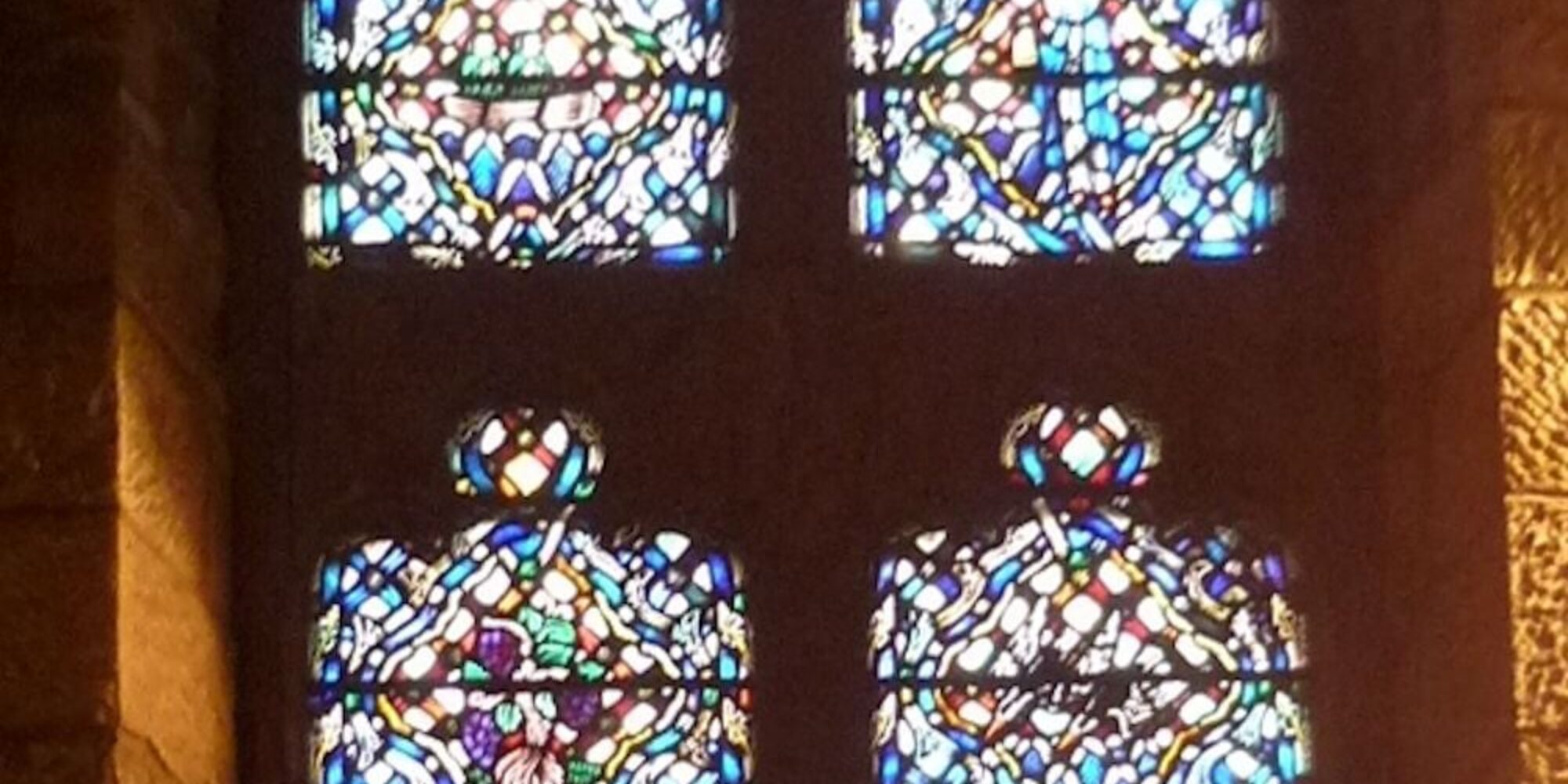
The building has continued to grow and change over the centuries. The Nave was altered in 1719 and again in 1833 under the designs of David Hamilton. Restoration work on the Quire followed in 1898, with further changes made in 1933. Today, the church houses an impressive collection of stained glass windows by Sir Edward Burne-Jones, Gordon Webster, and Douglas Strachan, along with the exquisite “Bothwell Embroideries.”
The most recent major restoration, completed in 2017, focused on safeguarding the future of the medieval Quire. Its striking stone-slab roof, built without timber supports, had placed immense pressure on the clay foundations, causing the walls to warp. Thanks to the extraordinary generosity of the congregation, local community, and supporters near and far, more than £2 million was raised to secure its future. A special service of rededication, attended by HRH The Princess Royal, marked the completion of the project.
Today, the church remains a place where history, faith, and community meet, and where the story of the Gospels continues to unfold.
The Church Building
Click any of the sections below for more information on the various areas of Bothwell Parish Church
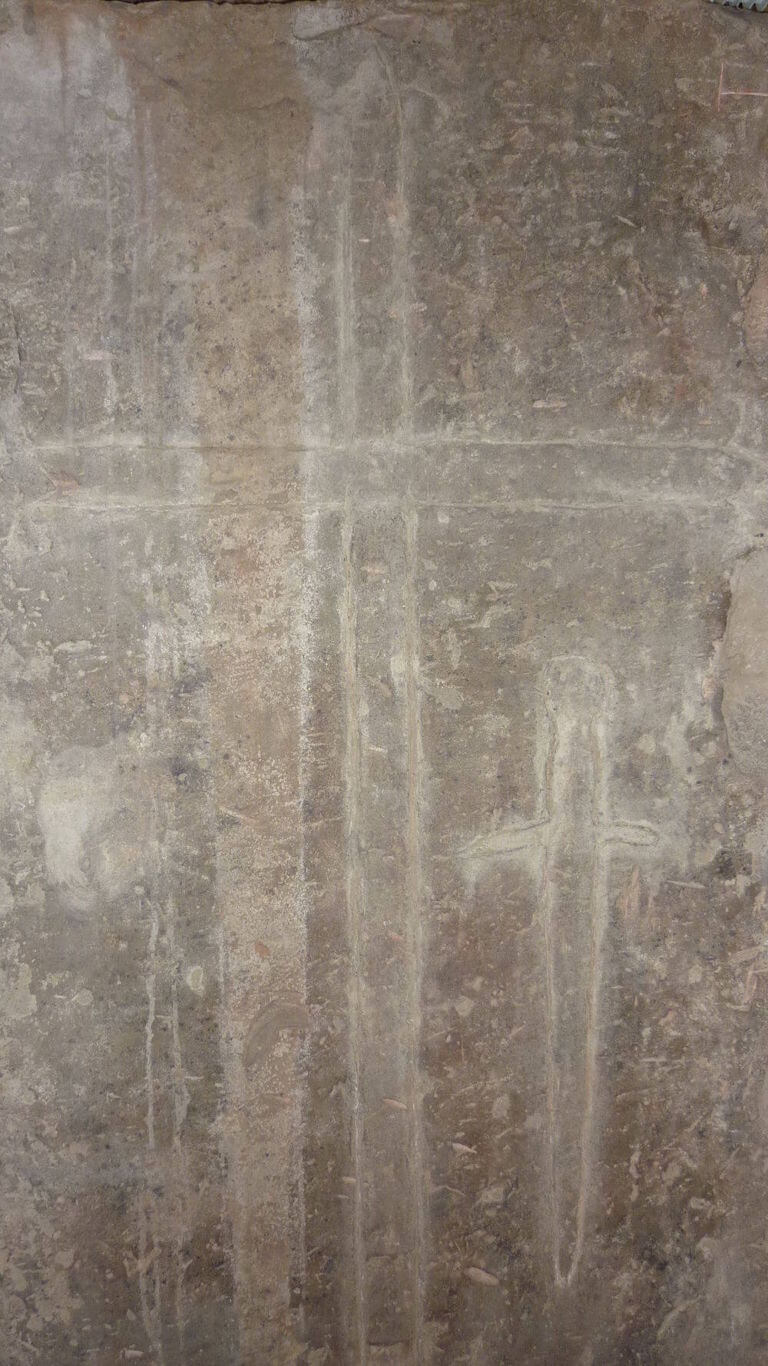
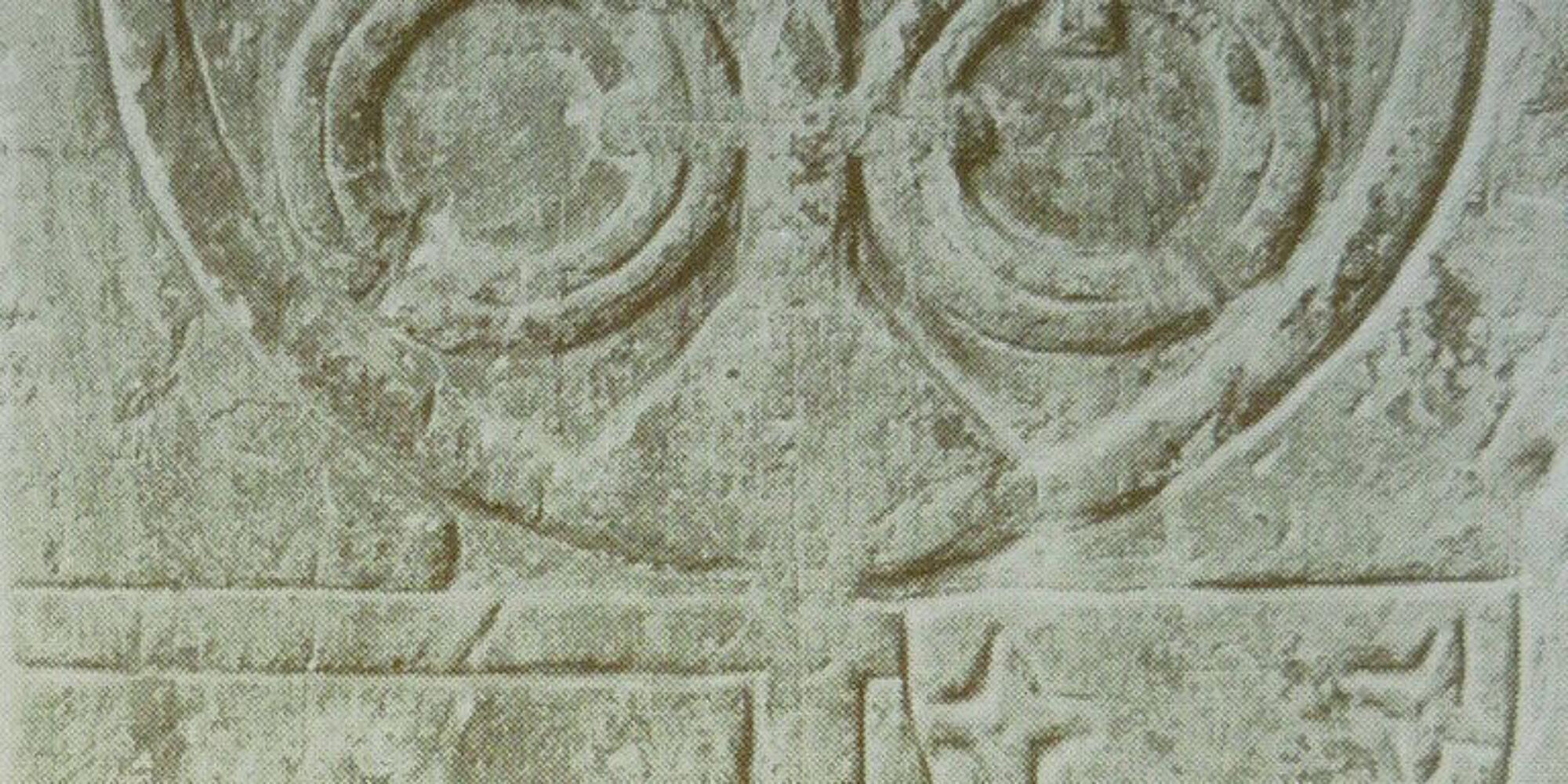
Near the entrance ramp on the west wall lies an ancient grave slab, believed to date from the late twelfth century. Almost complete, it shows an incised processional cross rising from a three-stepped plinth. Beside it is a simple carving of a sword, suggesting the grave belonged to someone of knightly or noble rank. With no inscription, the identity of the person buried remains a mystery.
Close by, on the north wall, is a smaller broken slab from a similar period, also engraved with a cross and sword. Further along the same wall is an unusual carved stone showing what many take to be an axe. In fact, it is a medieval mason’s gauge used for measuring and marking angles during the construction of the church. It may have been intended as the gravestone of a mason who died while working here and is thought to be the only example of its kind in Scotland.
Across the north and south walls of the nave, small alcoves hold fragments from the original Norman church founded in the mid-twelfth century. These pieces give a glimpse into the earliest stages of Bothwell’s long architectural story.
The Medieval Chancel
The fourteenth-century chancel, founded by Archibald Douglas—Archibald the Grim—as a Collegiate Church in 1398, houses several notable monuments. At the east end are the heraldic tombs of the First and Second Earls of Forfar. Along the north wall stands the ornate tomb of William Douglas, Third Duke of Hamilton, dating from 1696 and brought here after the old Collegiate Church of Hamilton was demolished in 1852.
Beside the Duke’s monument is the door to the former sacristy. It features ribbed vaulting and a medieval piscina set into the south wall. A second piscina sits on the opposite side of the chancel, alongside the sedilia, the seats once used by the clergy of the Collegiate Church during Mass. Also on the south wall is the only surviving medieval door in the building, known as the Priests’ Door.
Further Medieval Remains
Back in the nave, more fragments of the earlier Norman church are built into the walls. One of the most striking is a lintel inscribed in Gothic lettering with the name Magister Thomas Trayl, dating from the early fifteenth century. Thomas was the brother of Walter Trayl, Bishop of St Andrews (1385–1401), and appears to have served briefly as rector of Bothwell around 1408–09.
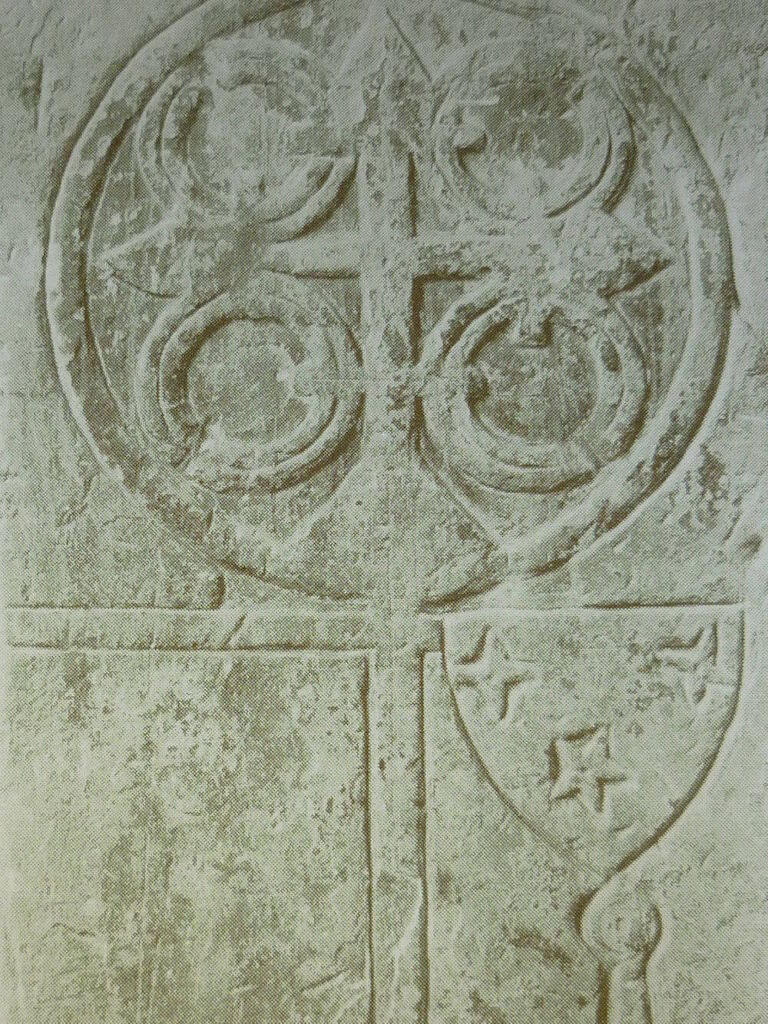
On the south-west wall is a large section of a grave slab likely linked to the Moray family, builders of the oldest parts of Bothwell Castle, or possibly one of their knights. The stone bears an incised sword and a shield decorated with the Moray arms of three mullets.
Hangings & Embroideries
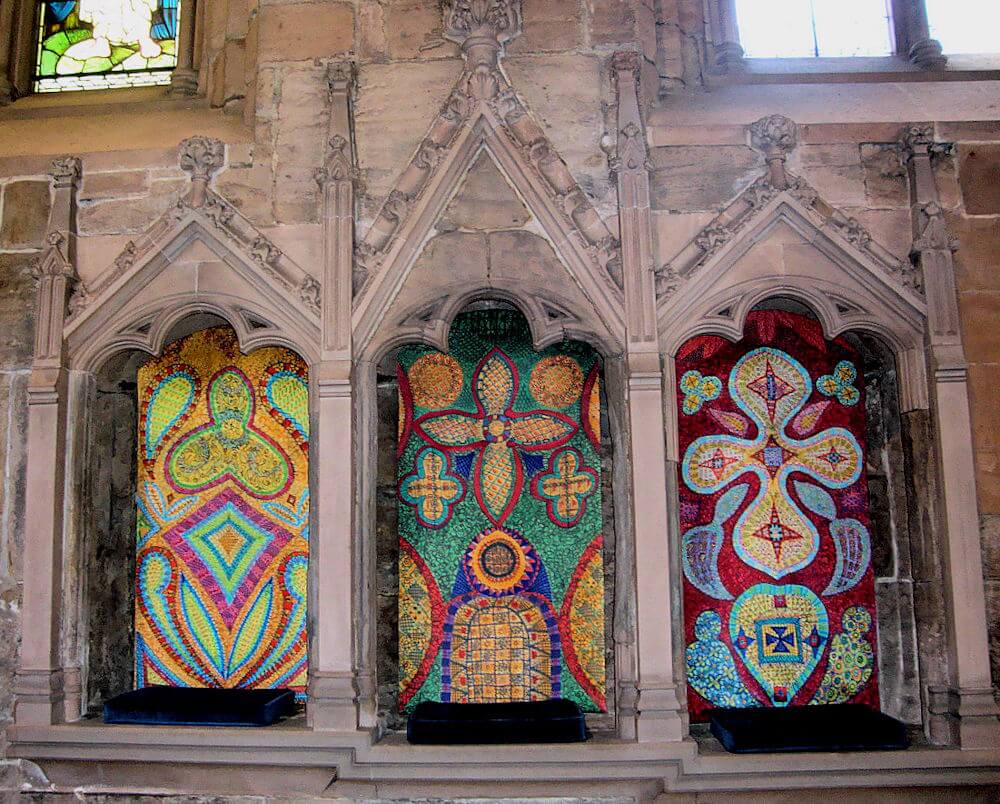
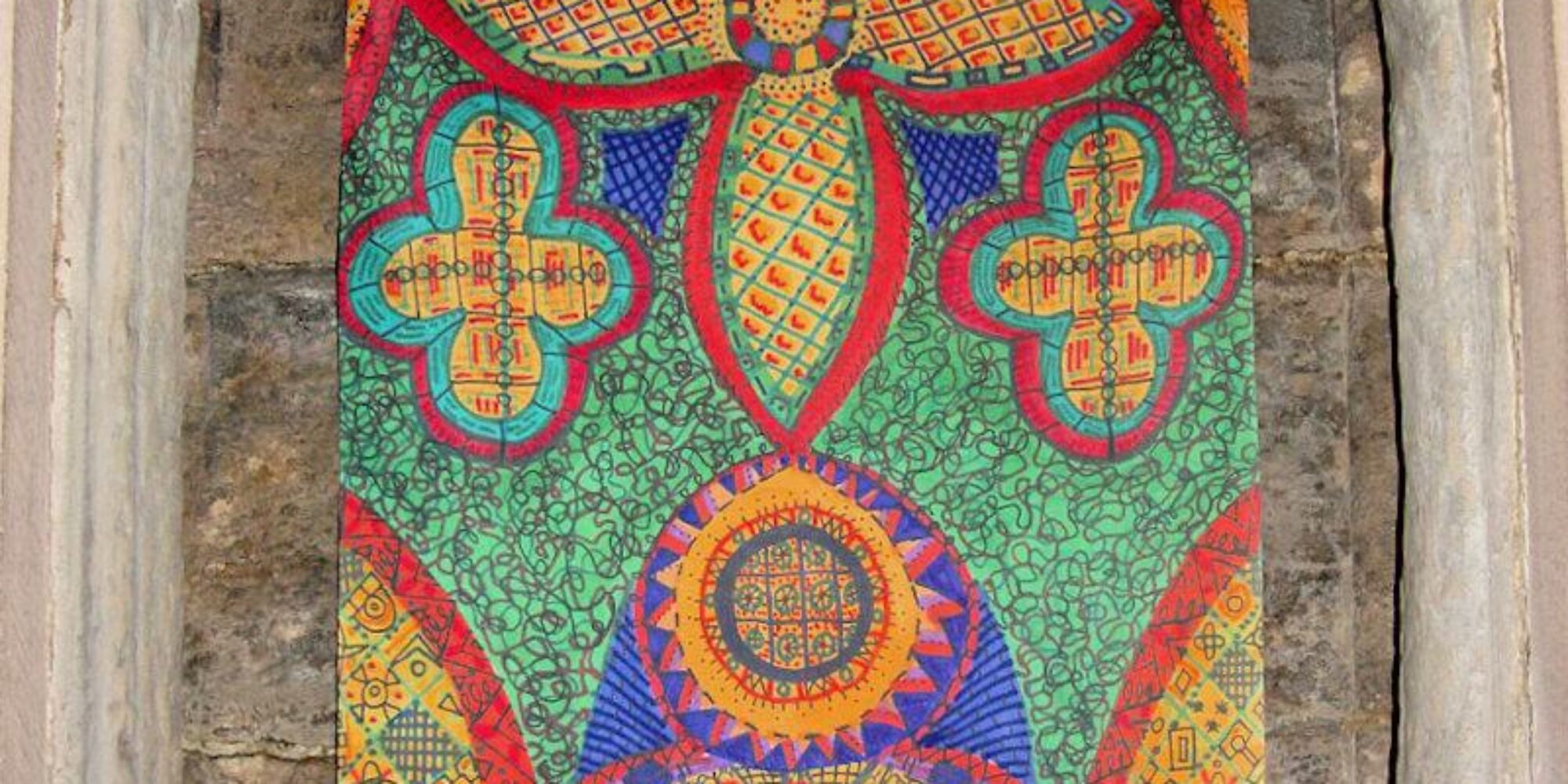
When visitors step into the Quire, their eyes are often drawn to the striking silk hangings displayed within the 14th-century sedilia on the south wall. These stone seats once held the senior priests of the Collegiate Church during Mass; above them hung a canopy and richly decorated back cloths, now long gone except for the fixing marks left behind.
Thanks to generous bequests in memory of Sandy Sinclair OBE, DL, and John and Elizabeth McCarte, the church commissioned new hangings to restore beauty to this historic space. The work was led by Ms Joanie Jack, senior lecturer at the Glasgow School of Art and an internationally recognised textile designer.
The project began by inviting pupils from local schools, Bothwell Primary, Muiredge Primary, and St Bride’s RC Primary, to explore the church and sketch patterns from its stained glass, carvings, metalwork, and stone. Joanie transformed their ideas into three exquisite designs, using hand-crafted techniques before digitally printing the finished artwork onto silk at the Centre for Advanced Textiles at Glasgow School of Art. These hangings now bring colour and life back to the ancient sedilia.
The Bothwell Embroideries
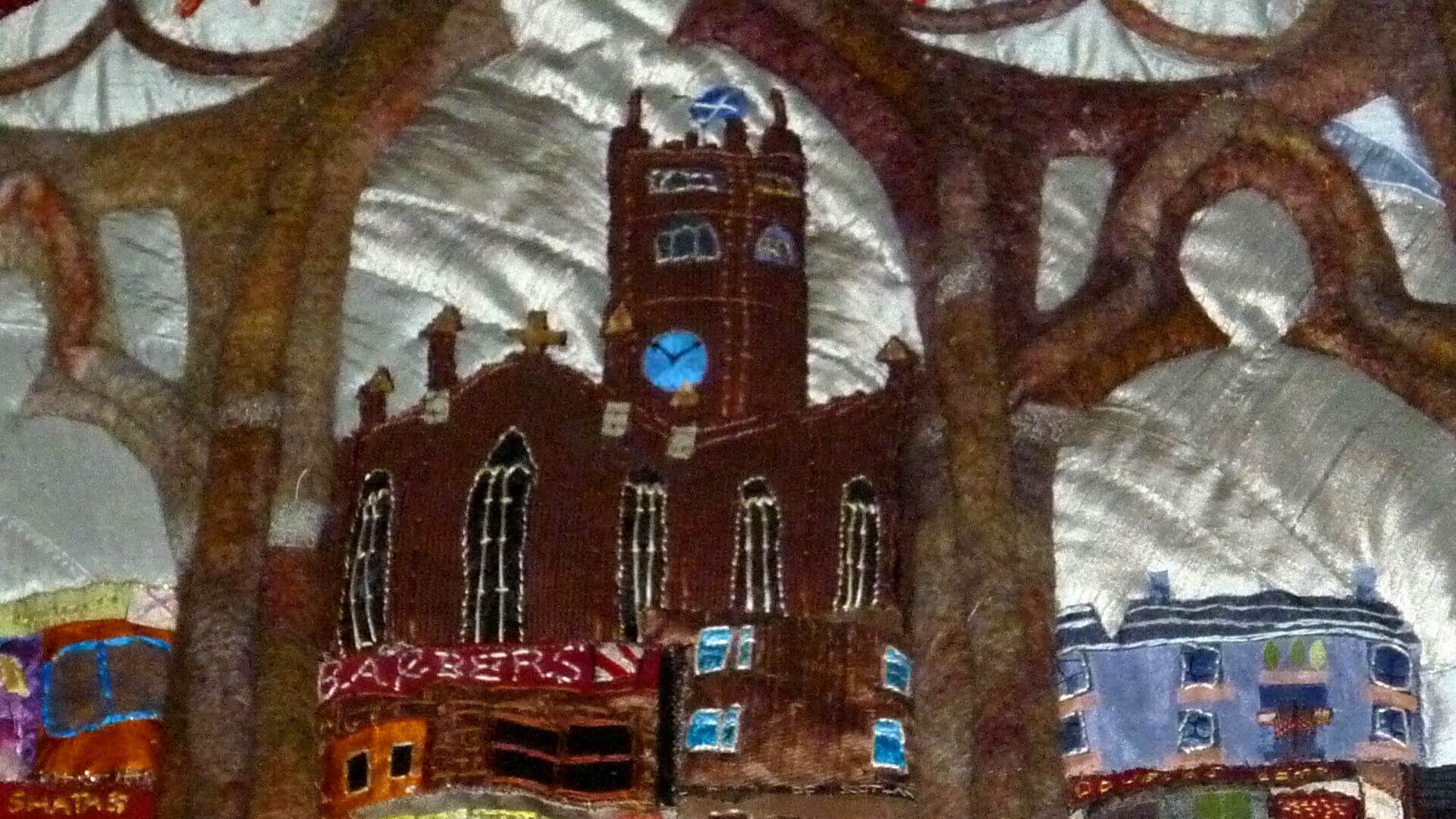
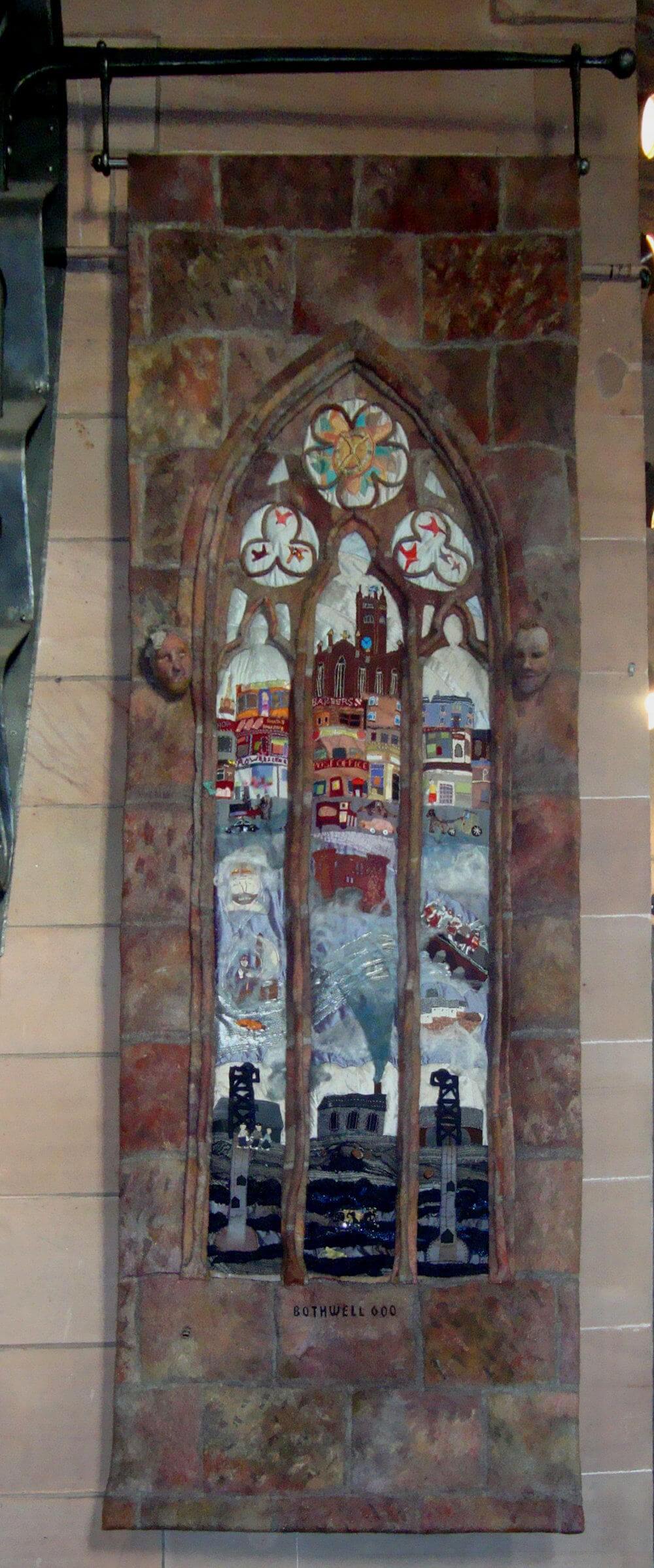
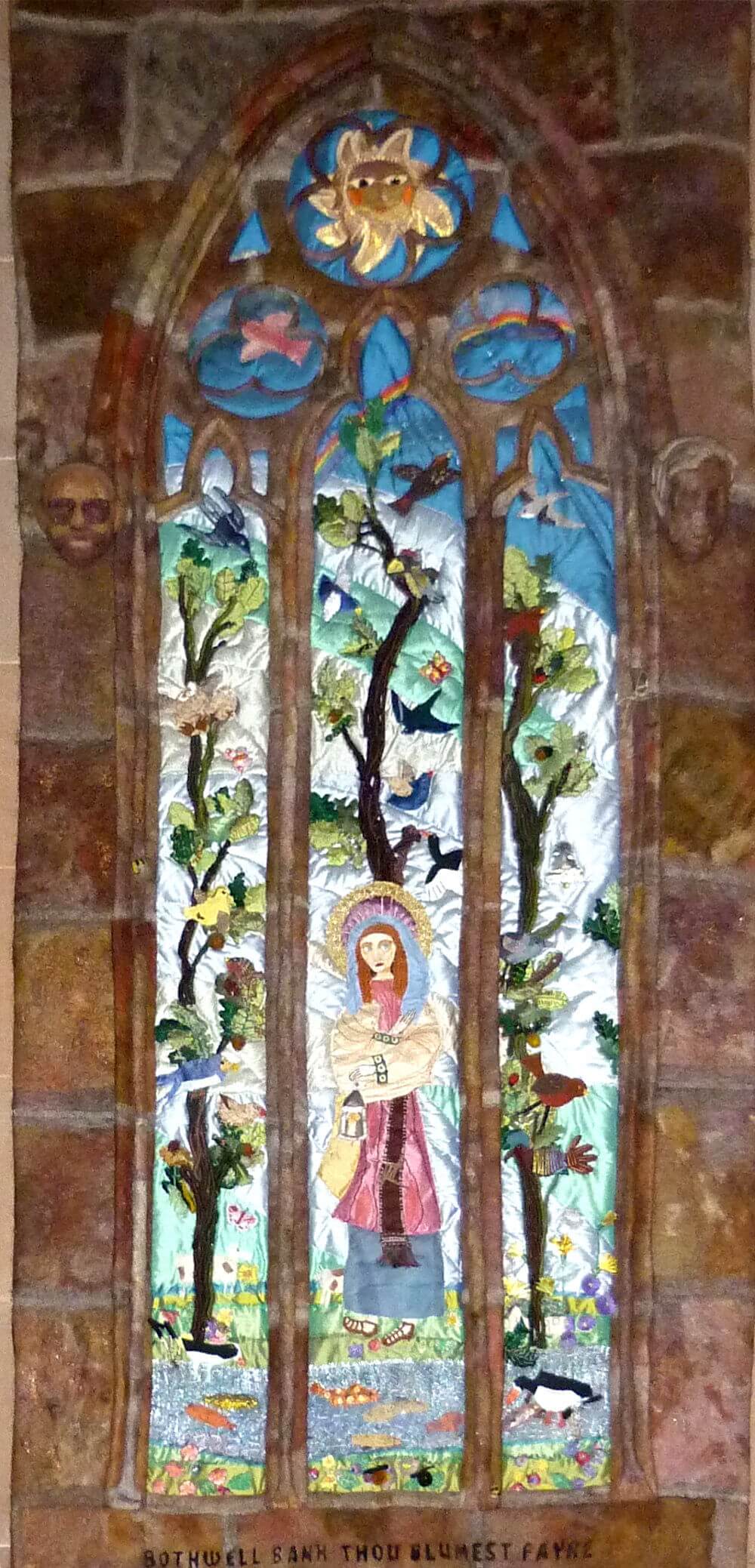
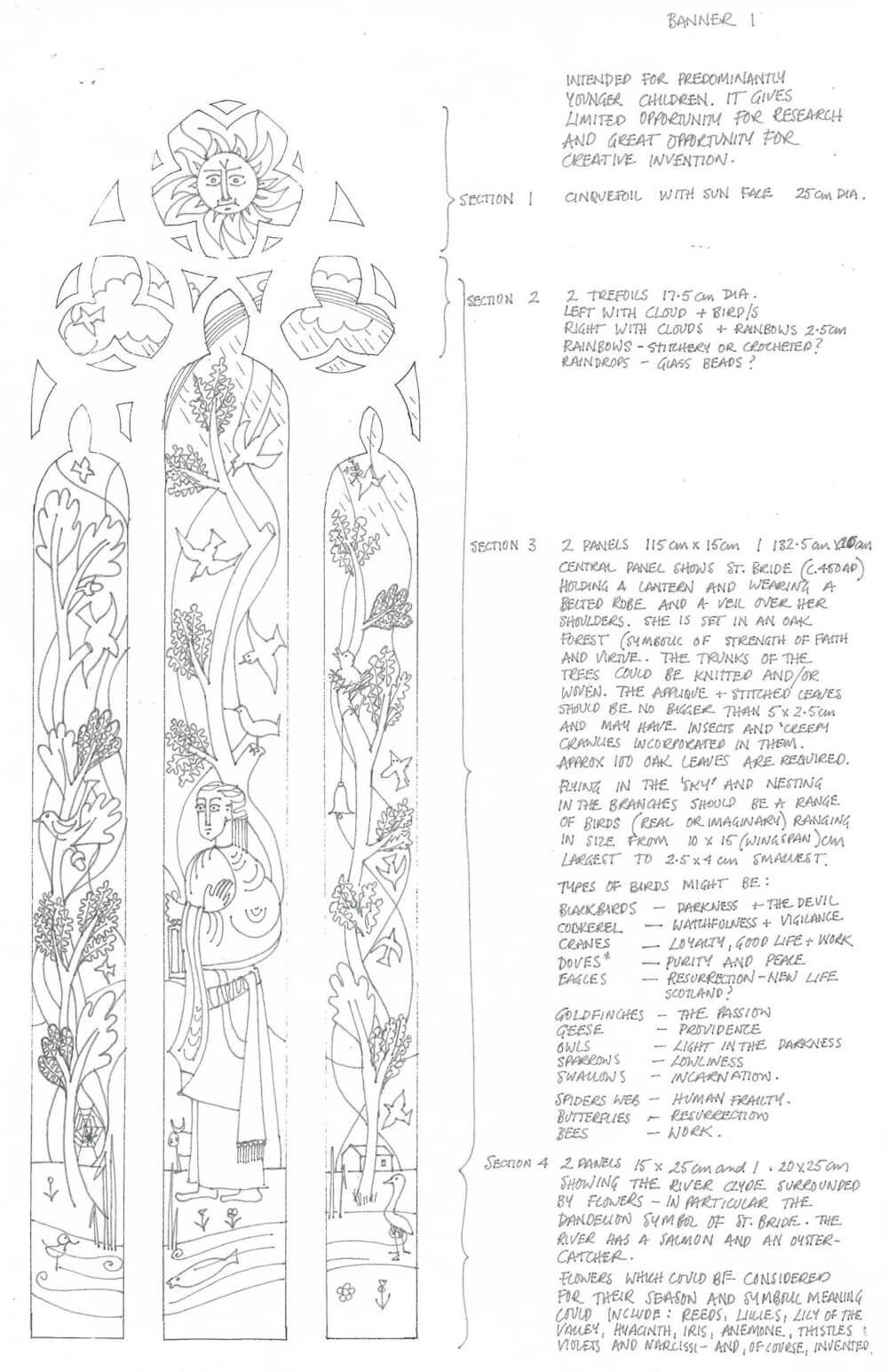
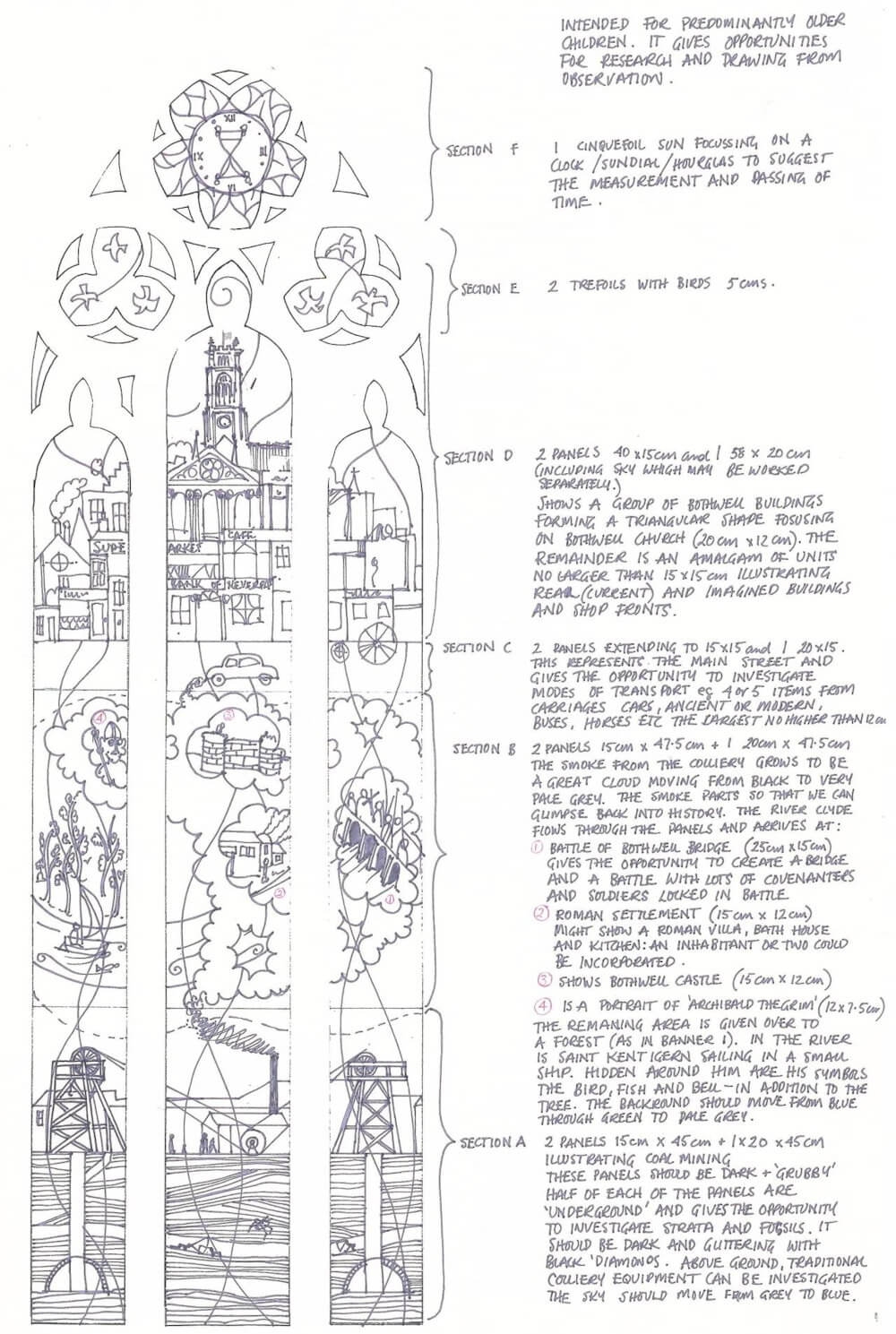
To mark the 600th anniversary of the church’s founding, a community project created the Bothwell Embroideries, now displayed on brackets as you pass through the choir. Designed by celebrated textile artist Malcolm Lochhead, one panel depicts Bothwell itself, its church, river, castle, former colliery and village life, while the other honours St Bride, surrounded by local trees, flowers, and birds, with the line:
“O Bothwell Bank, Thou Blumest Fayre.”
Malcolm Lochhead, Professor Emeritus of Glasgow Caledonian University, is widely acclaimed for his work in embroidery, textile art, and visual design, and is the recipient of the Lord Provost of Glasgow’s Medal for the Visual Arts. His working drawings show the layers of symbolism woven into the final designs.
The Quire
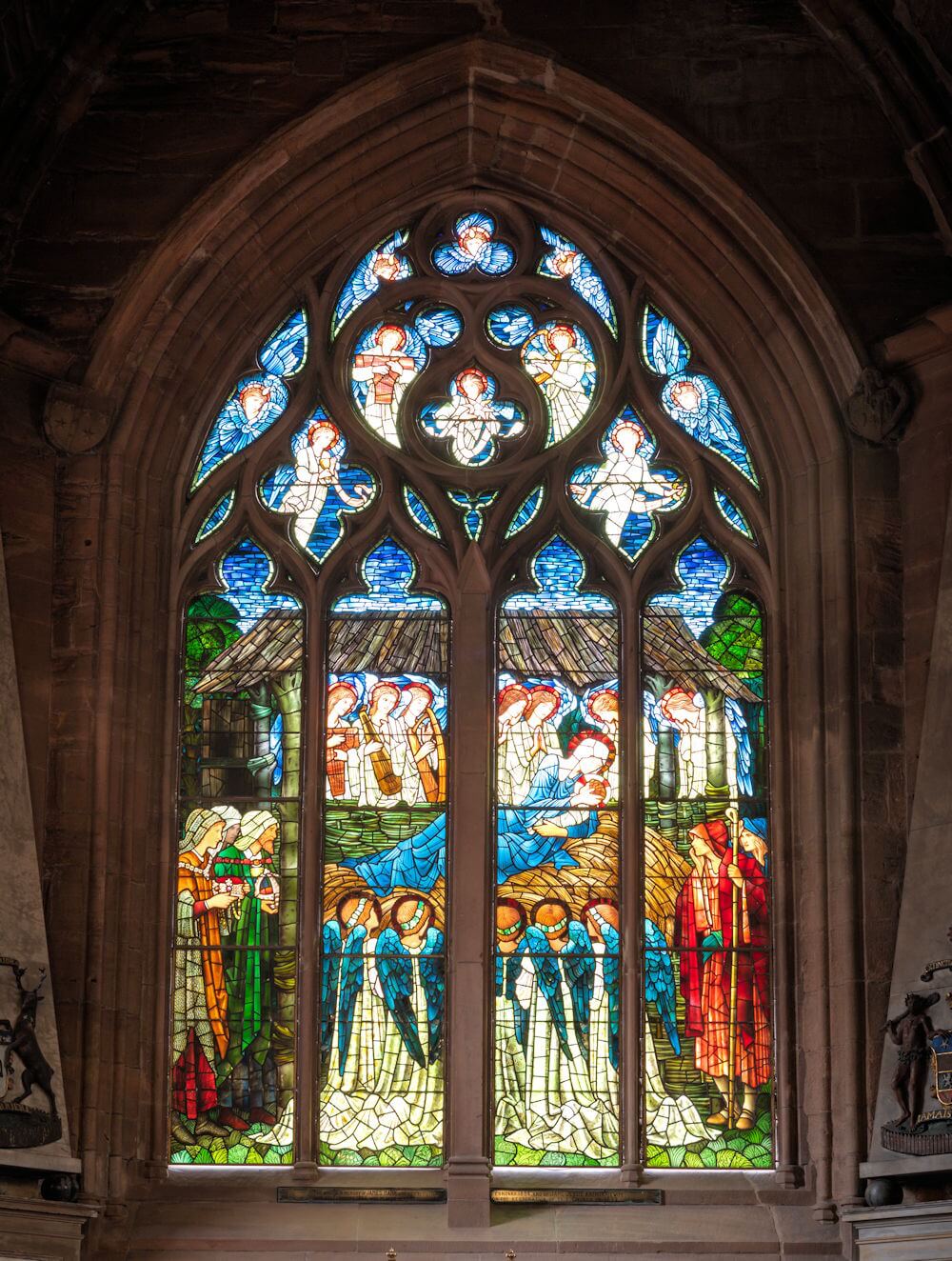
The jewel of the Quire is the magnificent East Window, a breathtaking example of late Victorian stained glass and often the first feature to capture a visitor’s attention. Created in 1899 by Morris & Co. of Merton Abbey and designed by Sir Edward Burne-Jones, it is one of the church’s artistic treasures.
The window depicts the Nativity: Mary lies beneath a simple thatched canopy, cradling the Holy Child as hosts of angels surround them in praise. More angels fill the tracery above, while on the left the three kings, including one portrayed with darker skin, approach with their gifts. On the right, the shepherds stand in wonder at the sight of the newborn Christ.
The artist’s skill is particularly evident in the way the Virgin spans two lights of the window without appearing divided, a hallmark of Burne-Jones’s delicate craftsmanship.
Beneath the window, a brass plaque records its dedication:
“This window, in memory of James Mann, who died at Bothwell, February 1884, and of Jessie Arthur, his wife, who died February 1865, was placed here by their family on the restoration of this Church in 1899.”
The South Window
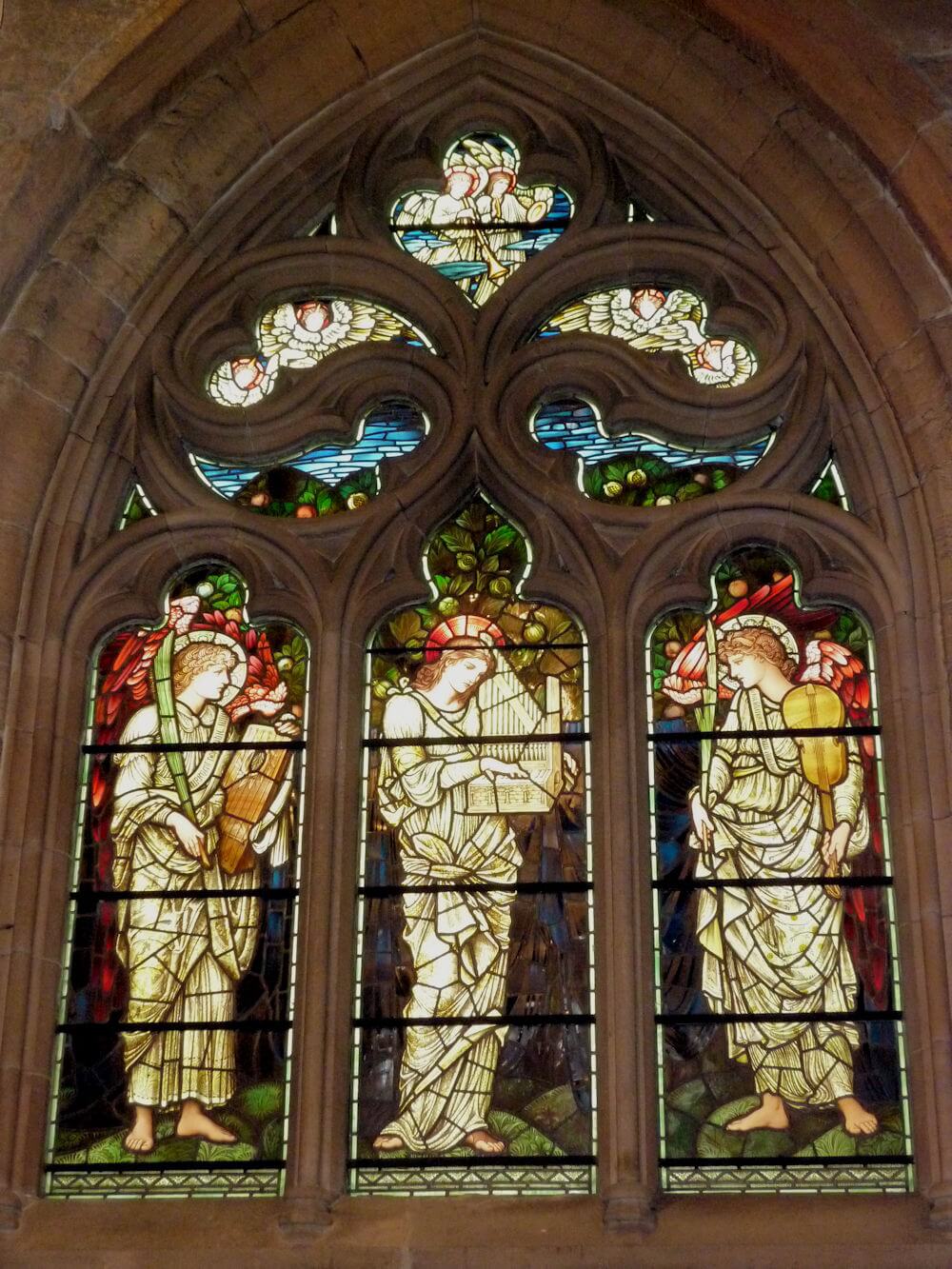
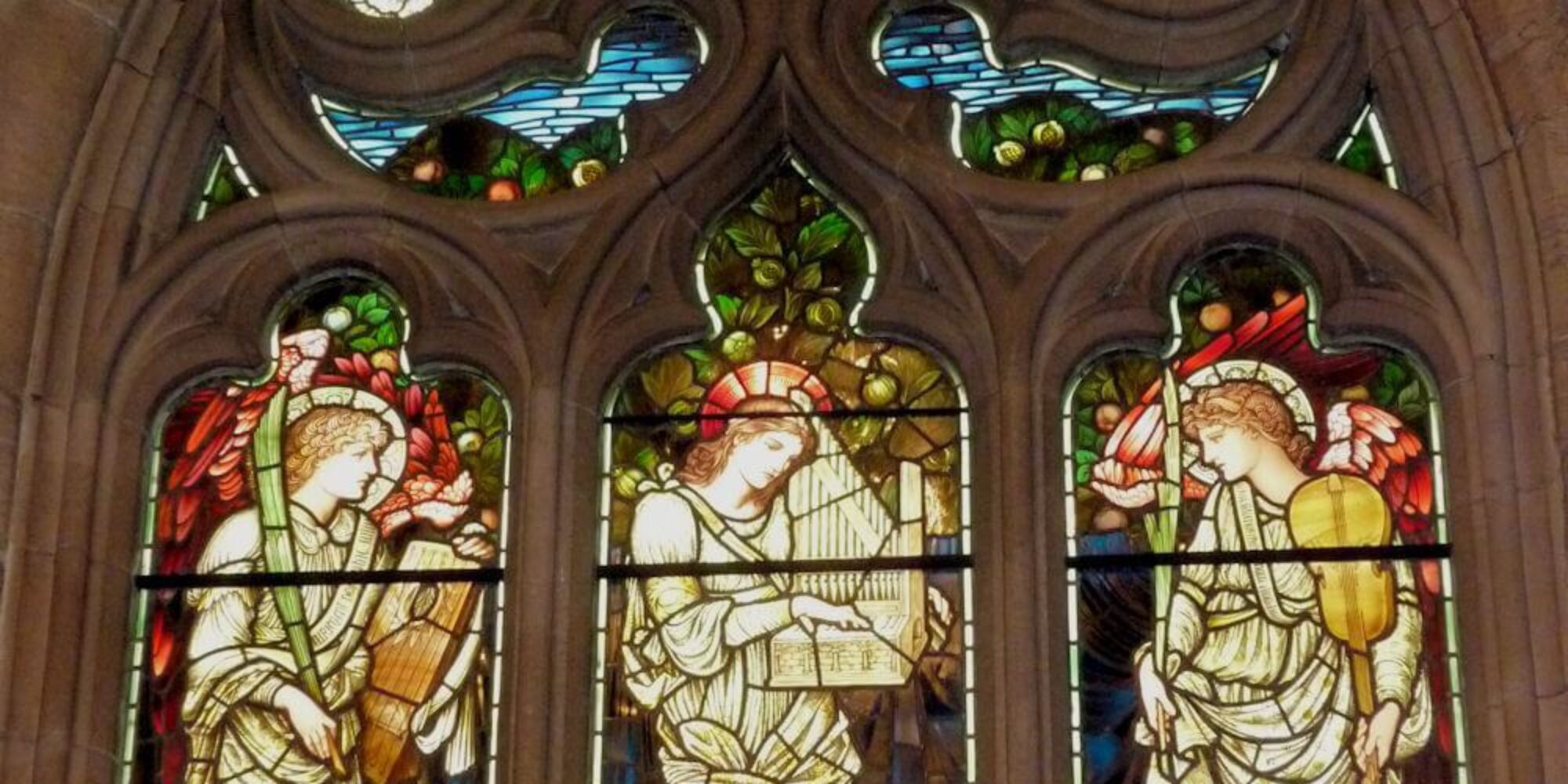
Beside the great East Window stands a smaller three-light window on the south wall, also designed by Sir Edward Burne-Jones and produced at the Merton Abbey studio in 1907. Its style echoes the larger window: in each light, an angel makes music, as though joining the praise offered by the heavenly host depicted opposite.
A brass inscription below reads:
“In loving memory of Jean Arthur, beloved daughter of John and Jane Wordie, who died 22nd February 1902, in her fifteenth year.”
Jean was a grandchild of the family who gifted the window.
The North Window
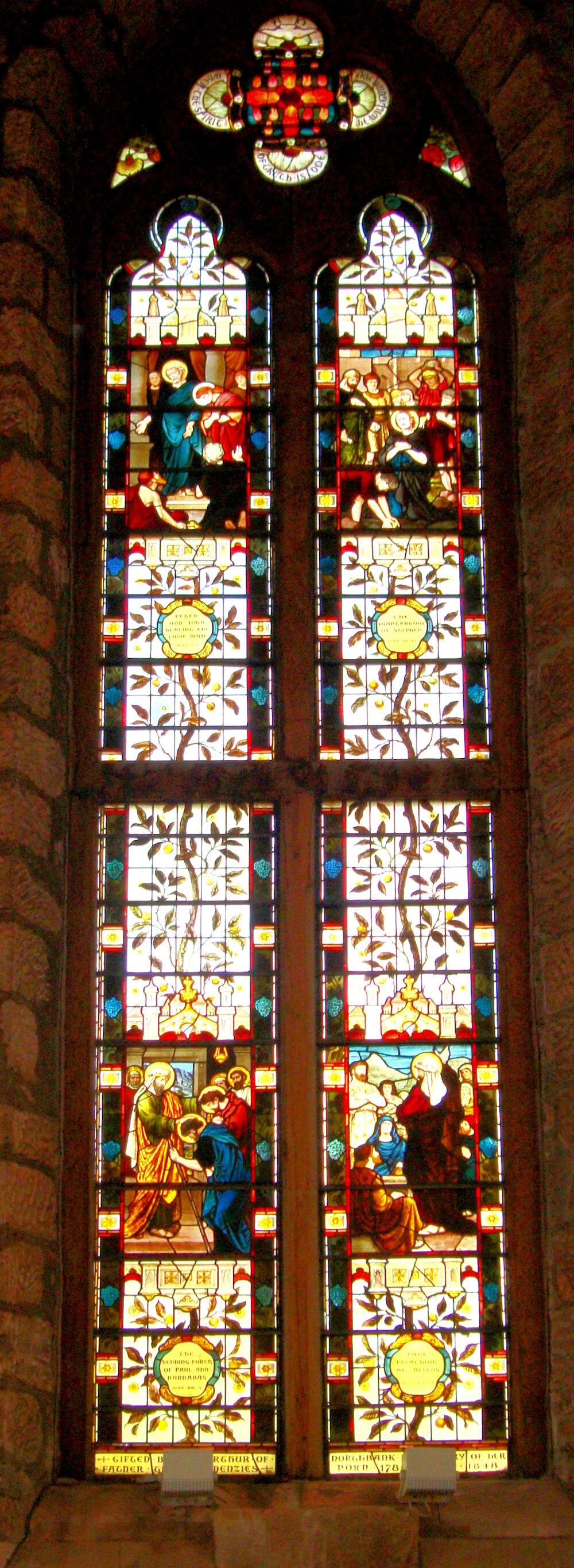
Installed in 1897 and crafted by Cottier & Co. of London, the North Window is a beautifully detailed two-light window that reflects key moments in the early life of the Church, drawn from the Book of Acts.
The left light shows Peter and John healing the lame man (Acts 3:6) and the sending forth of Paul and Barnabas (Acts 13:3). The right light depicts the martyrdom of St Stephen (Acts 7:60) and Paul preaching in Athens (Acts 17:22). Each scene is set within small, square panels framed by architectural motifs, all connected by the elegant imagery of the Tree of Life.
In the quatrefoil at the top, the artist portrays the “cloven tongues of fire” that descended at Pentecost, surrounded by the words:
“When the Spirit of truth is come, He will guide you.”
Above sits the dove, symbol of the Holy Spirit, and the alpha and omega, reminding us of Christ as the beginning and the end.
Along the base of the window is the dedication:
“Gifted by Mrs Arthur of Northbank in memory of her father, Thomas Menzies, born 1786, died 1848.”
The Centre Window
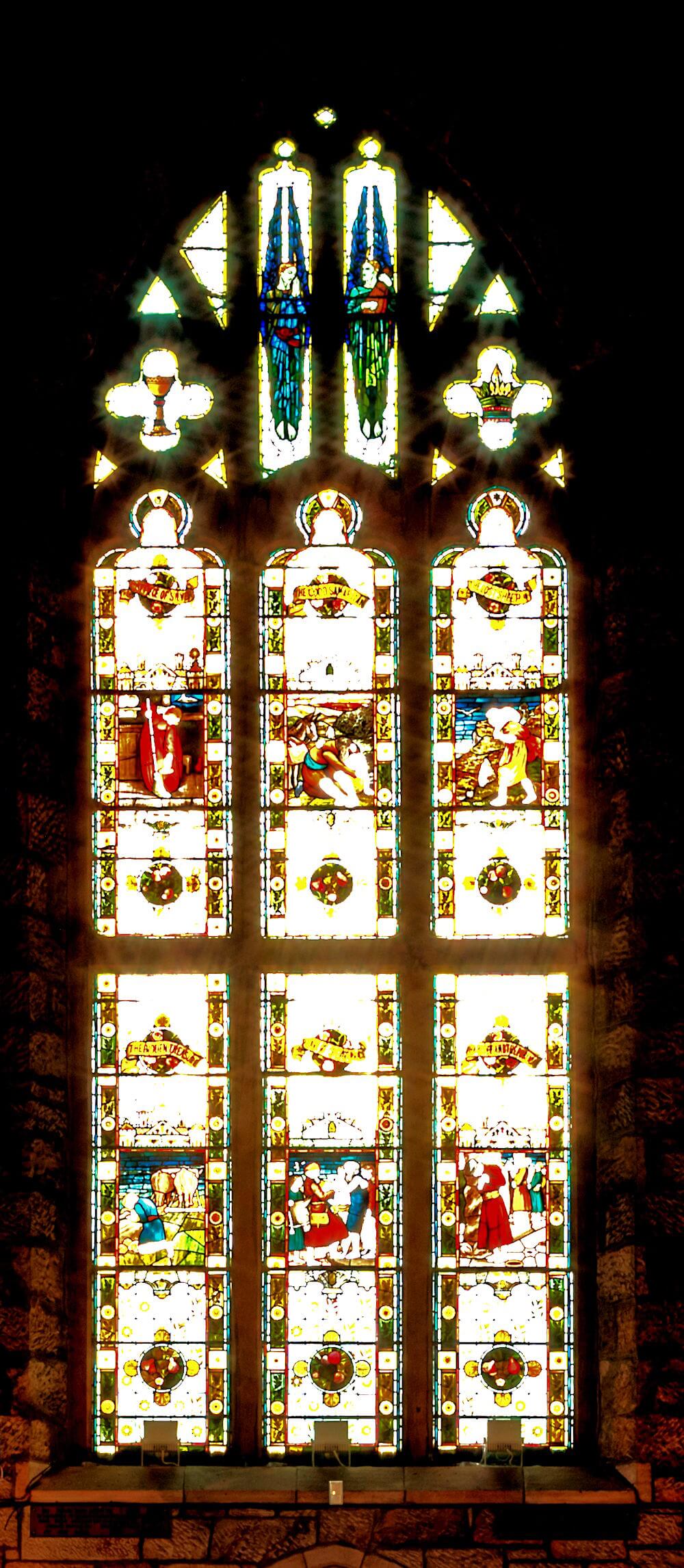
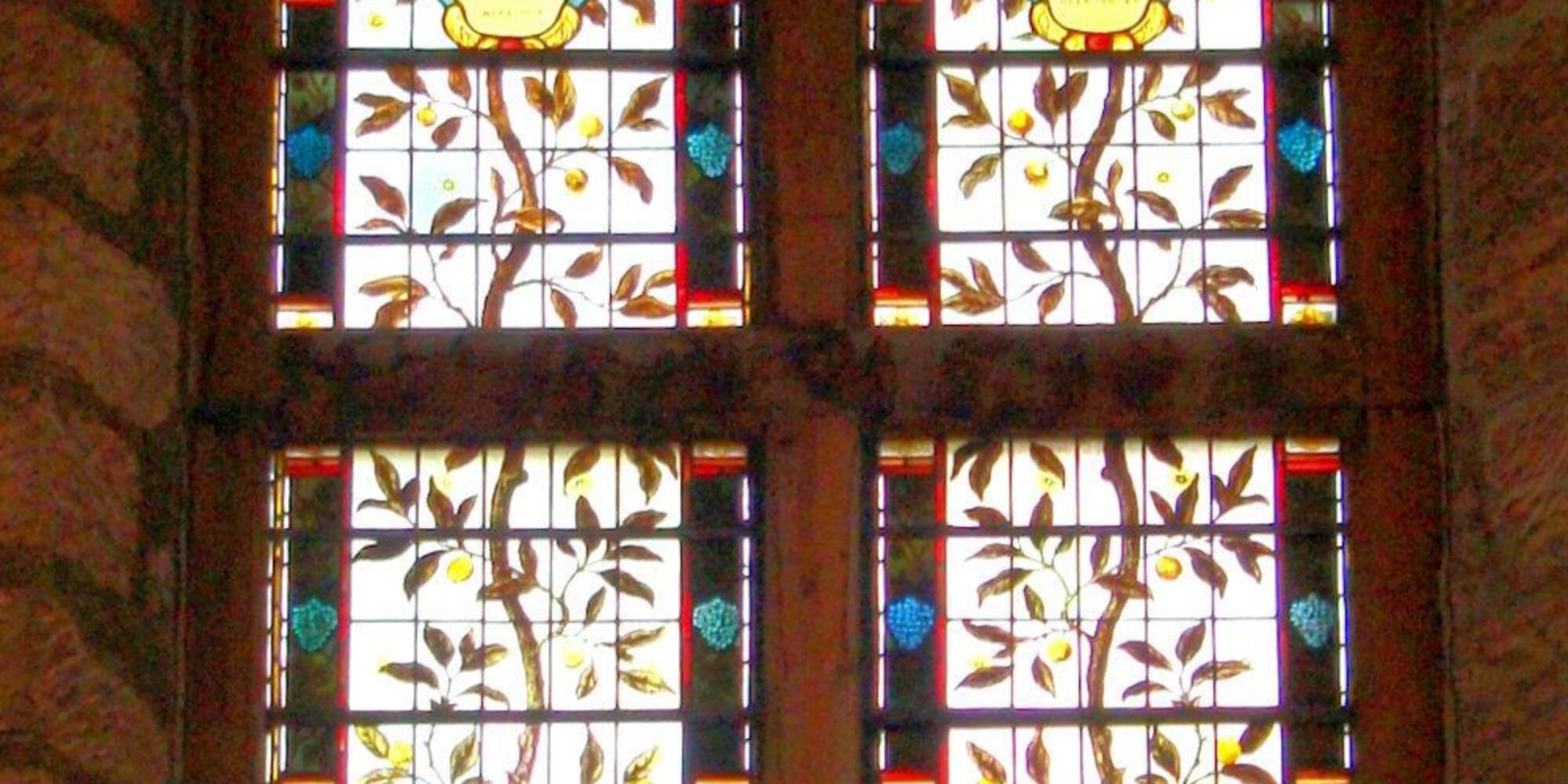
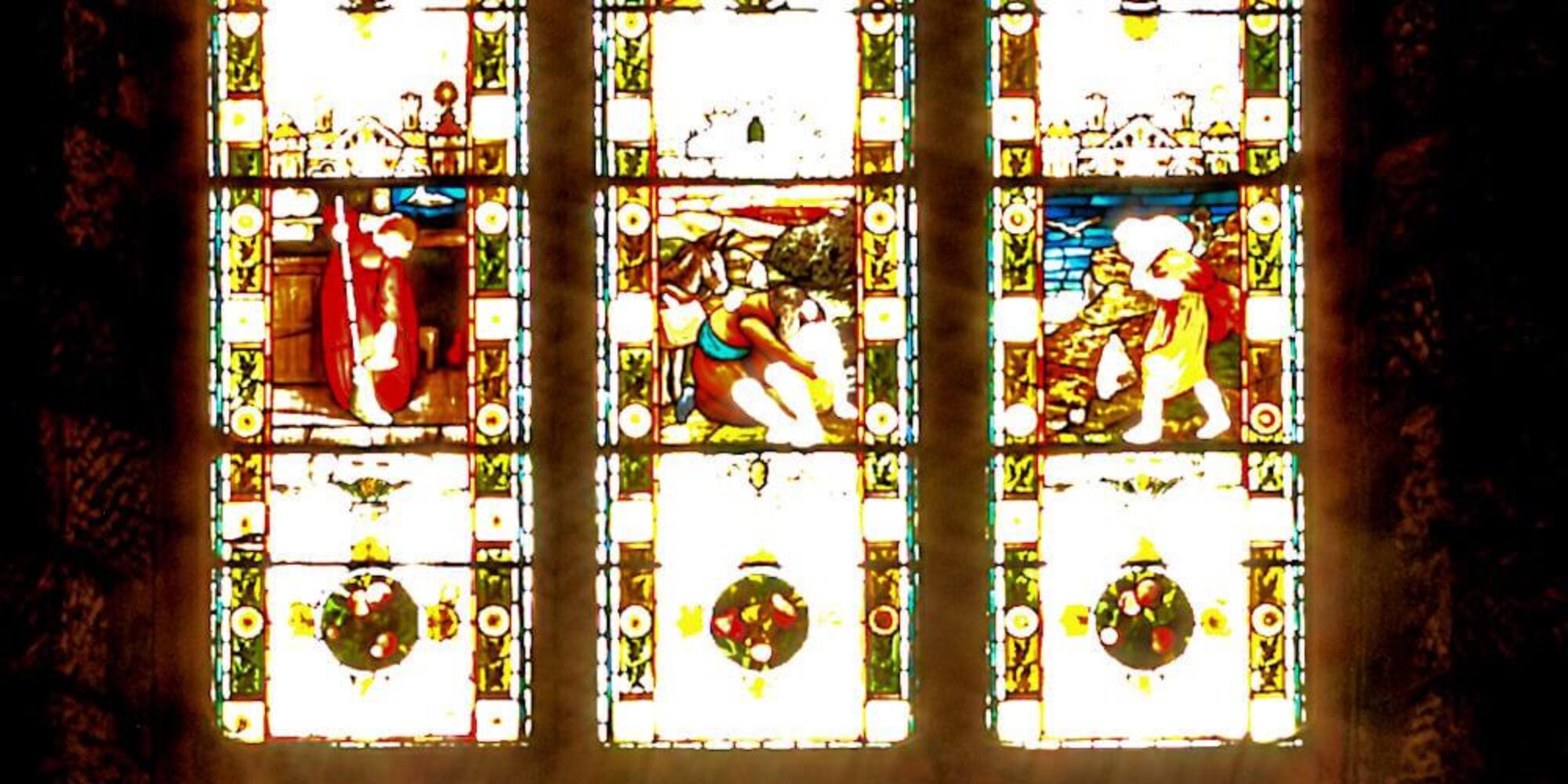
The Centre Window, created by Cottier & Co. of London in 1880, is a three-light window illustrating six of Jesus’ parables. The main scenes are based on drawings by Sir John Everett Millais RA, first published in the 1860s in Good Words, a magazine edited by Dr Norman Macleod.
The parables are arranged in pairs:
Left Light – The Lost Coin and The Hidden Treasure Centre Light – The Good Samaritan and The Pearl of Great Price Right Light – The Lost Sheep and The Pharisee and the Publican
Each story appears within a small square panel framed by early decorative architectural motifs. Above each one, an amber scroll on a floral background carries the name of the parable. A rich border of green and yellow chrysanthemums surrounds the three lights, adding warmth and colour.
A brass plate beneath the window records its dedication:
“This window was gifted by Mr James Donald in appreciation of the order in which the parish church graveyard had been put by the Heritors of Bothwell during the ministry of the Rev. John Pagan MA, March 1880.”
At the very top of the window are two angels representing Praise and Prayer, added in 1933 when renovation work revealed an area of plain glass in the tracery. Designed by G. MacWhirter Webster, the angels are accompanied by symbols of a crown and cup within the quatrefoils.
Another brass plate below notes:
“The stained glass in the tracery is in memory of John Purdon Brown, Abertay (1864–1928), and his son John Spence Brown (1906–1933), both devoted workers in this church. Gifted by the widow and sisters of the former, 1933.”
Outside and around the Church
Gargoyles and Local Characters
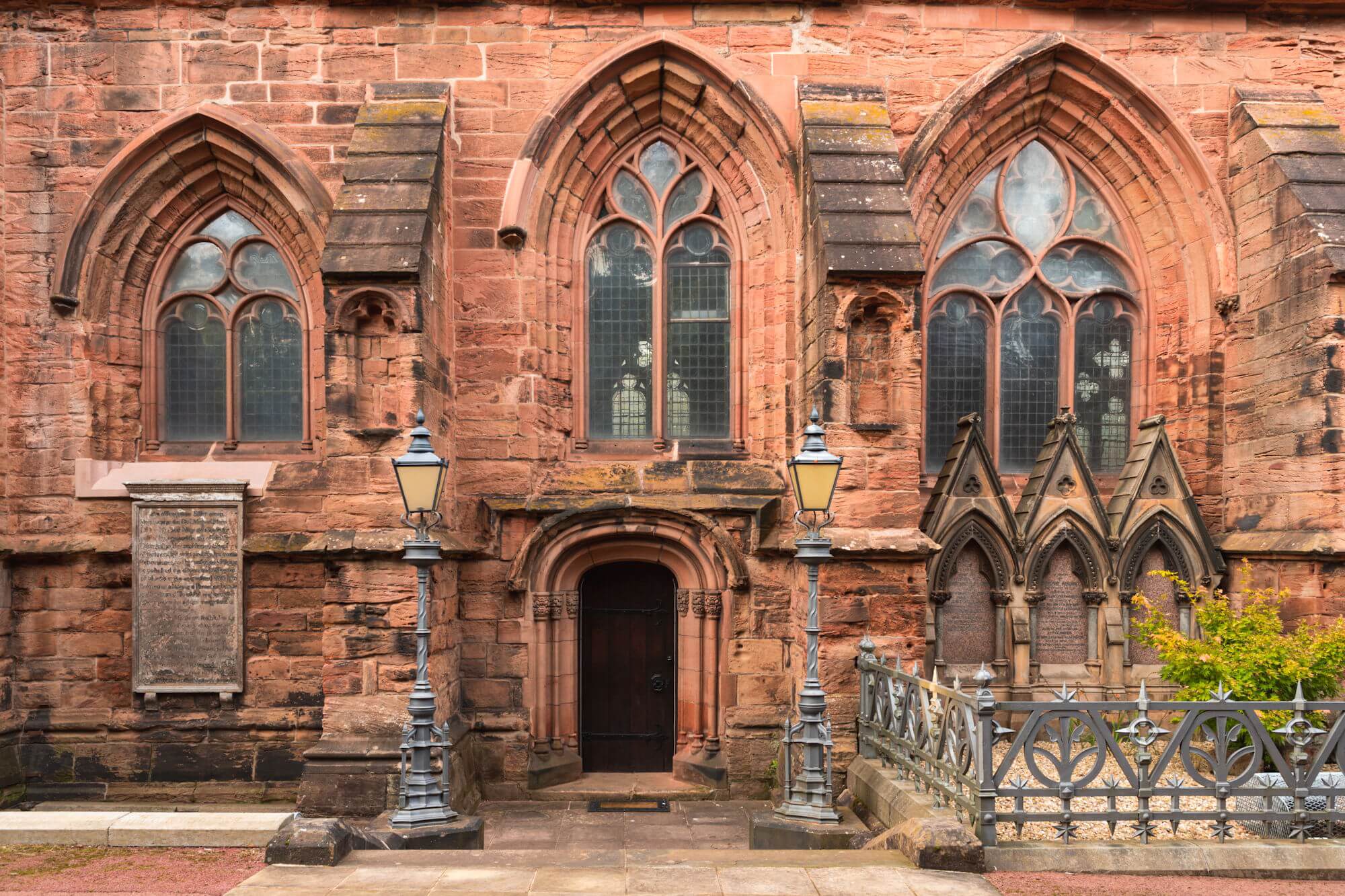
Outside, several noteworthy details decorate the church’s exterior. Many window hood-mouldings end in gargoyles carved faces said to represent local figures from the early 19th century. Those on the north side are unknown, but several on the south side have been identified.
Second Window:
Left: believed to be Jamie Redd (Read/Reid) of Holytown, remembered for his love of jovial company his carved face still “grins.”
Right: Jenny Inglis, who lived in the Kirkstyle tenements near the Douglas Arms. A respected figure in Bothwell, she served on the Wells and Greens Committee (from 1816) and later became a key-holder for the Thorntree Well.
Third Window:
Right: Margaret “Meg” Steele, proprietrix of the Douglas Arms, affectionately known as “Cleanly Meg” for the spotless condition of her inn.
Fourth Window:
Left: William Allan, Bothwell’s schoolmaster, or “Dominie” or nearly 40 years. His appointment caused a famous dispute with the minister, Dr Michael McCulloch, which escalated all the way to the House of Lords before being resolved in Allan’s favour.
Fifth Window:
Left: Jamie Watson, the village gravedigger.
The Priests’ Door and the Sinner’s Niche
The medieval Priests’ Door is also worth noting, its roof still covered with original hand-cut stone tiles. Beside it are two unusual cavities carved into the wall—a small round hole and a shallow oval depression beneath it. Together they form what is believed to be a “sinner’s niche.” An iron staple once sat in the upper hole, holding a chain and collar. The person doing penance would kneel, the collar around their neck, with their head placed in the oval niche below.
The Hozier Burial Ground
To the right of the Priests’ Door is a small enclosed burial ground containing graves of the Hozier family. One grave remains unoccupied; the central one belongs to Catherine Margaret Hozier, grandmother of Lady Clementine Churchill (née Hozier), wife of Winston Churchill.
The Russell Thomson Memorial Window
Location
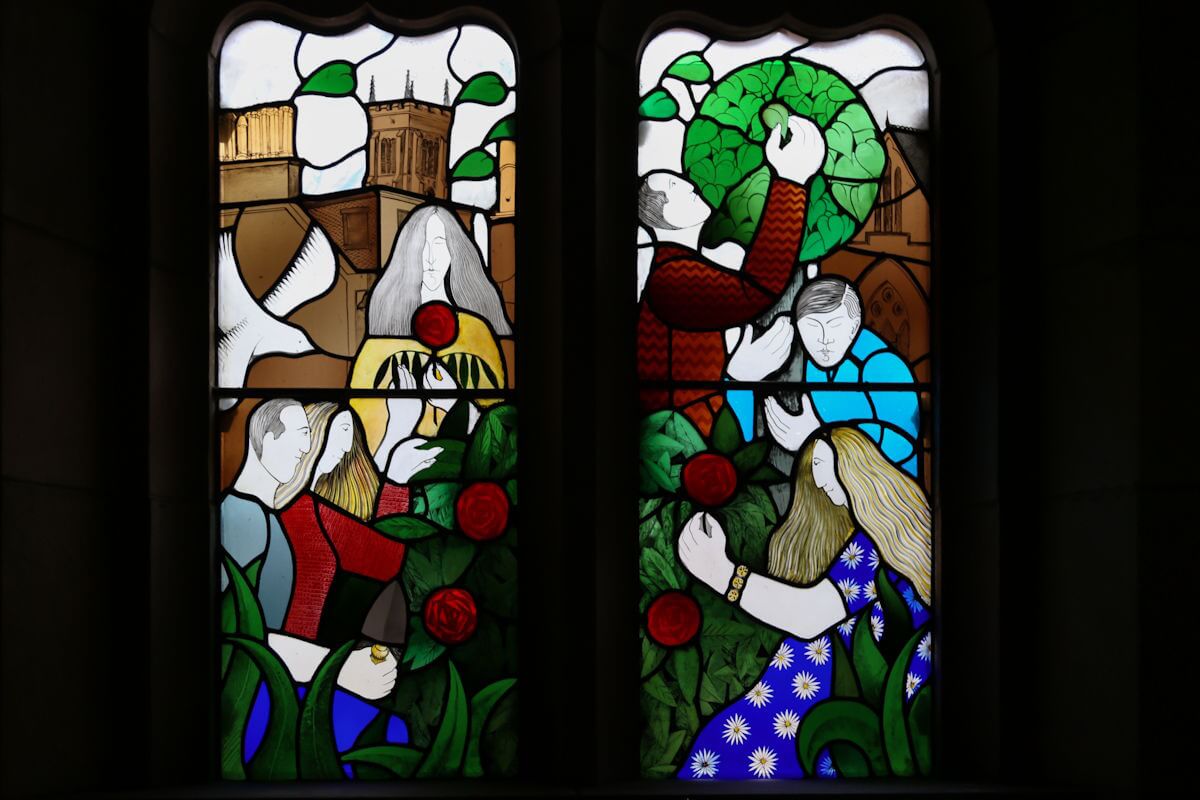
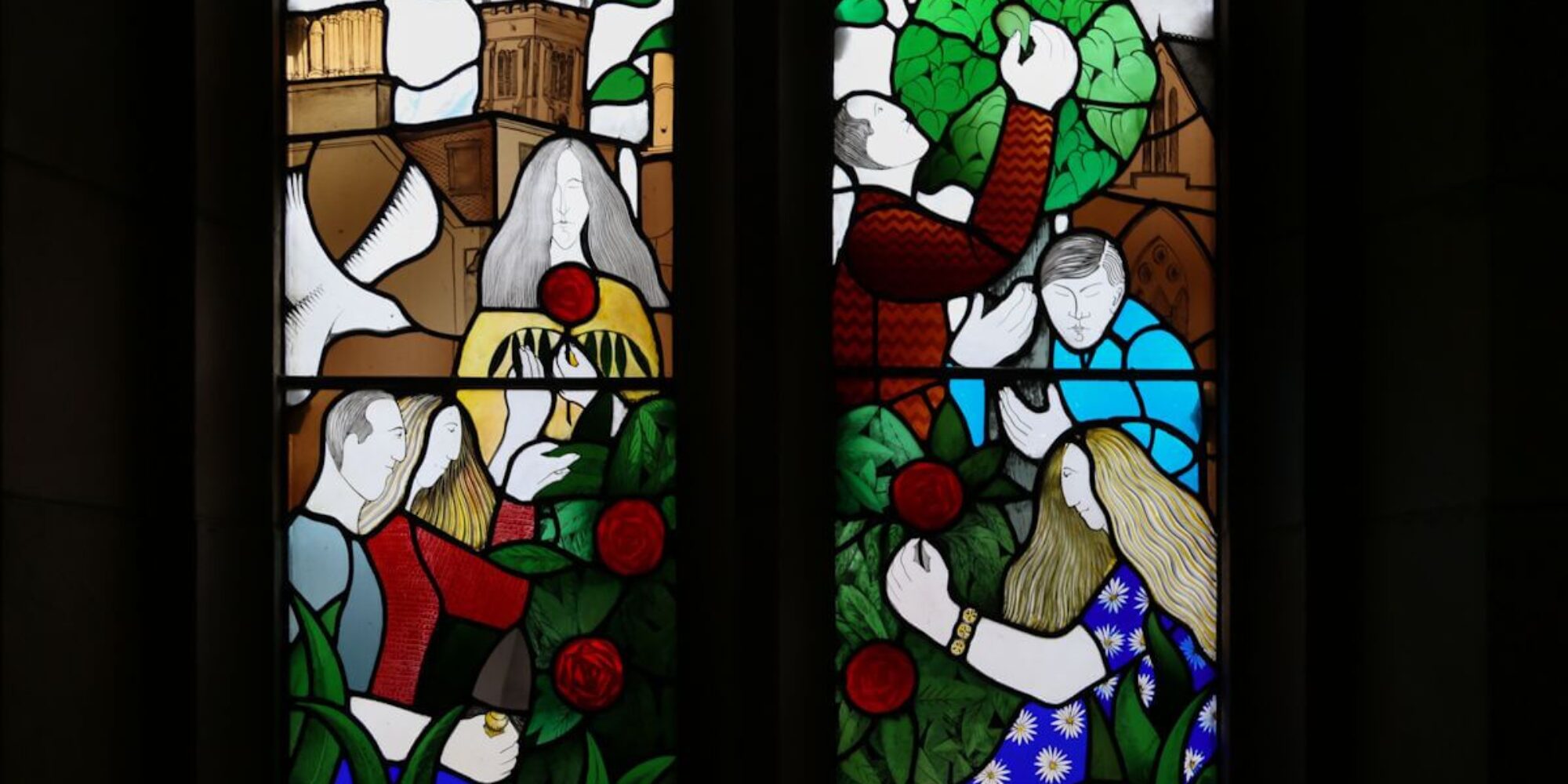
Located on the west wall beside the main entrance, the Russell Thomson Memorial Window is a beautifully detailed two-light window, each panel measuring around 4 by 1.5 feet. Positioned at the end of the centre aisle and only a little over five feet from the floor, it is often seen up close by visitors as they leave the church, making its fine detail all the more striking.
Design
The window honours Russell Thomson and his passionate commitment to environmental design, most notably through his work with the Bothwell Village Association and Bothwell in Bloom. These organisations helped restore Bothwell’s character as a Victorian garden village and were instrumental in securing its status as a conservation area.
At the centre of the design stands a rose bush, symbolising growth, beauty, and care for the natural world. Around it, six figures of different ages form a protective circle: In the right foreground, a maternal figure extends an arm and flowing garment to shelter the rose. Behind her, a young person planting a tree represents the future. Beside him, an older man tending falling leaves reflects the passing nature of life. A slender woman in yellow stands behind the rose, holding a bloom her sun-coloured clothing symbolising hope and new life.
To the left, a white dove a Christian sign of peace, reminds us of the shared dependence of all creatures on a healthy environment. Beneath it, a kneeling man and woman working together speak of unity and collective responsibility.
The background features architectural elements from Bothwell, including the distinctive tower of the Parish Church, anchoring the window in the life of the village.
Method
The window would be executed in the traditional manner of leaded stained glass with extensive use of paintwork, staining, aciding and sandblasting techniques.
The North Transept
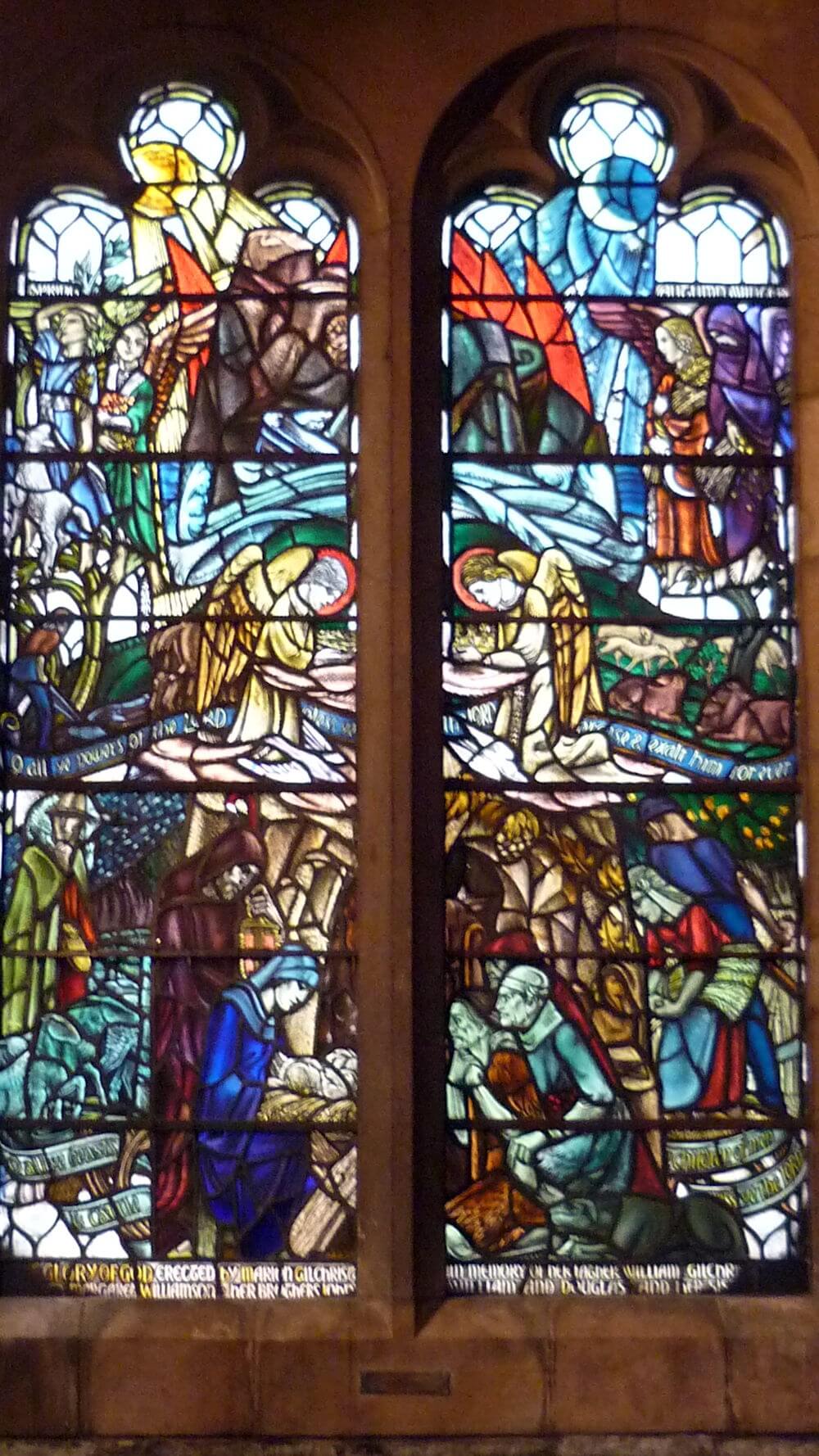
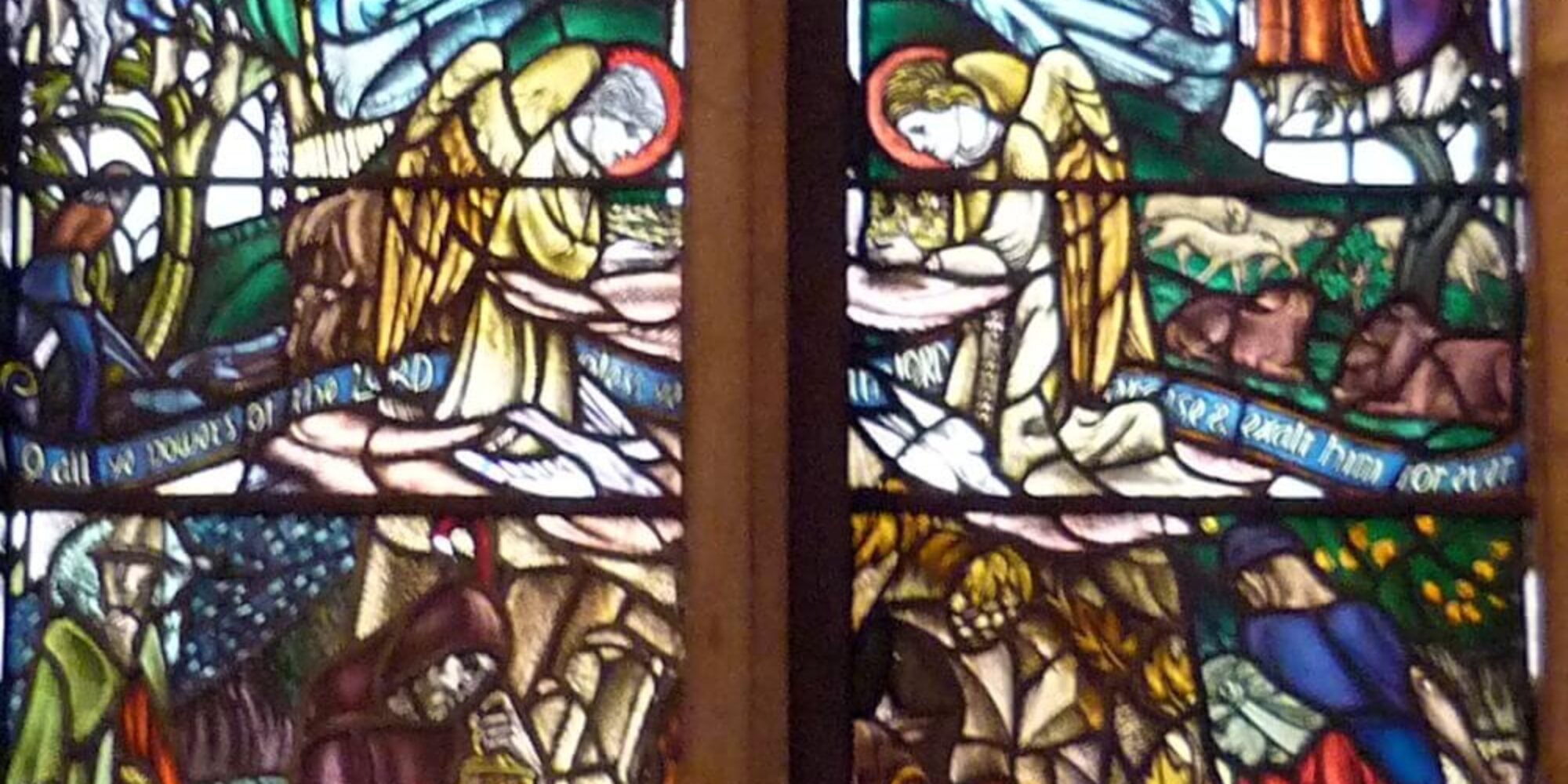
The North Transept houses a striking stained-glass window designed by Dr Douglas Strachan LL.D. in 1936. Its theme is Thanksgiving, with praise rising from all creation and culminating in joy at the birth of Christ.
At the top, the four elements—Earth, Fire, Water and Air—are vividly portrayed in rich colour. Below them, two angels, Joy and Gladness, carry the crowns of thorns and victory. The lower section contains a simple Nativity scene, linking creation’s praise with the humility of Bethlehem.
Agricultural and pastoral imagery fills the window in tribute to the Gilchrist family, to whom it is dedicated. The four seasons appear as graceful female figures, and scenes of rural life—ploughmen, shepherds, birds and harvesters—surround the central images.
Two scriptural lines frame the window:
“O all ye powers of the Lord, bless ye the Lord…” “O all ye beasts and cattle, ye children of men…”
The dedication reads:
“To the Glory of God. Erected by Marion Gilchrist in memory of her family.”
The Gilchrists were a remarkable family: William a successful farmer of Bothwell Park; his sons pioneers in agricultural science; and his daughter Dr Marion Gilchrist the first woman to qualify in medicine from a Scottish university (Glasgow, 1894).
Strachan’s wider work appears in St Paul’s Cathedral, the Guildhall, the Palace of Peace in The Hague, and the Scottish National Shrine in Edinburgh Castle.
The South Transept
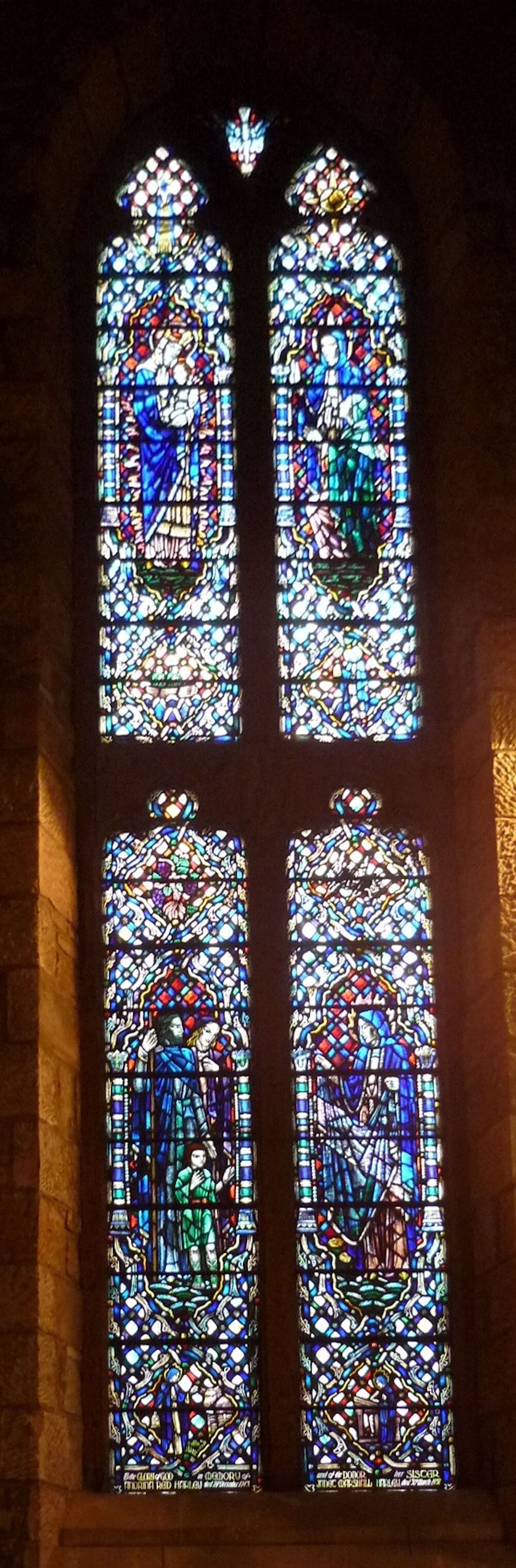
In the South Transept stands the Harley Window, dedicated in 1954 in memory of Andrina Reid Harley and gifted by her sister, Janet Marshall Harley. Designed and executed by Gordon M. Webster, it depicts scenes from the life of St Bride patron saint of the Black Douglas family, though only loosely connected to the church itself.
The window is arranged in interlacing panels illustrating key moments from St Bride’s story. In the upper left, the Virgin Mary holds the infant Jesus beneath the guiding star, while on the right St Bride known as the “foster mother of Jesus” looks on with her distinctive flaming halo. Her sister Dara and a blind nun accompany her, and above them shines the sun, recalling the description of St Bride as the “sun among stars.” A dove in the tracery echoes another title: the “dove among birds.”
In the lower panels, St Bride hangs her cloak on a sunbeam, dandelions at her feet, while the poor whom she served stand opposite. Below, medallions show her reading with a cow in the background she is the patron saint of dairy workers and writing an illuminated manuscript.
The upper medallions tell the story of two children lost at sea and guided home by St Bride: the children and their boat on the left, and St Bride holding her lamp on the right.
The dedication reads:
“To the Glory of God, and in memory of Andrina Reid Harley (d. 24 December 1943) and the donor, Janet Marshall Harley (d. 30 March 1951).”